
Small Entryway Ideas: How to Build a Useful Drop Zone in a Tight Space
A measurement-first guide to small entryways, narrow hallways and homes with no foyer, covering door swing, shoe storage, hooks, shallow furniture, mirrors, lighting and renter-friendly layouts.
A tiny entryway does not need to hold everything that enters the house. It needs to make arrival and departure easier without blocking the route through the door.
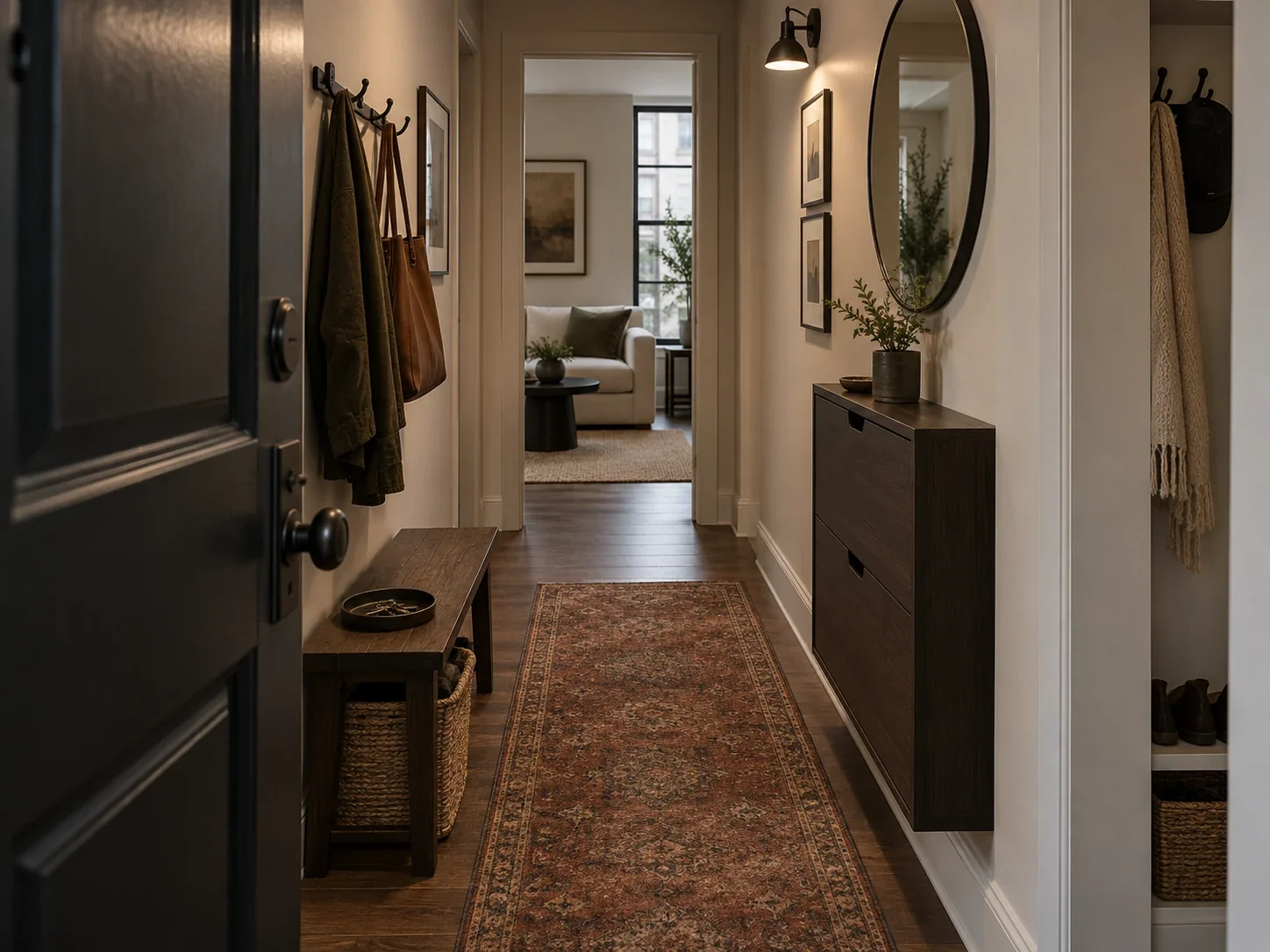
What matters most
- 01
Protect the door swing and walking route before adding furniture.
- 02
Store only the shoes, coats, bags and small items that genuinely need to live by the door.
- 03
Use wall height before adding more floor furniture in a narrow entry.
- 04
Choose shallow storage from its real depth and opening mechanism, not from the word “slim” in a product title.
- 05
Create a complete arrival routine: somewhere to drop, hang, store footwear, check the mirror and leave again.
Start with the route through the door, not the console table
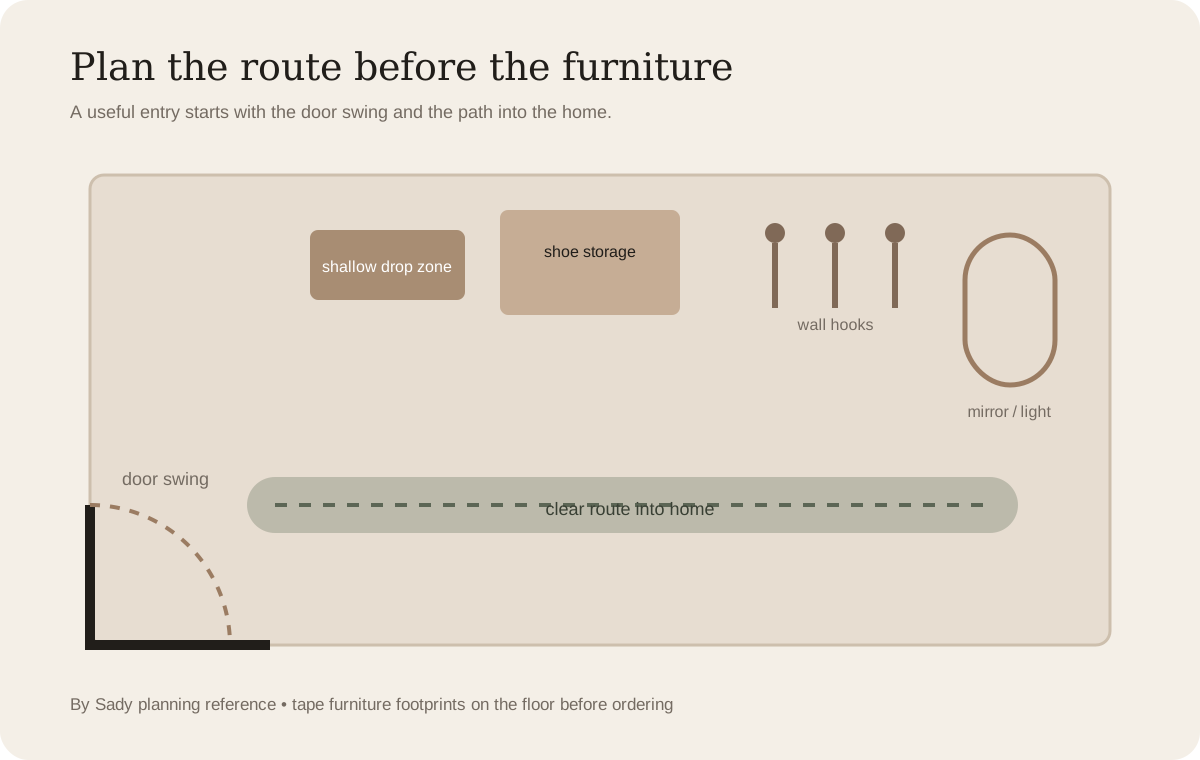
A small entryway has one job that outranks decorating: it has to let people enter, close the door and move into the home without stepping around furniture or piles of shoes. Draw the door swing first, then mark the route people actually take after they come inside.
Measure the usable wall width only after the open door, trim, radiator, switches and other fixed obstacles are accounted for. Then measure how much depth the route can tolerate. A cabinet can be narrow in width and still project too far into a tight hall.
If the front door opens directly into a living room, treat the first strip of wall and floor as an entry zone rather than trying to recreate a full foyer. The goal is to establish the functions of an entryway without stealing more space than those functions need.
Decide what is allowed to live by the door
Entryways become crowded when they are asked to store every coat, every shoe and every bag a household owns. Separate the active rotation from the archive. The entry should hold the items used in the current week; off-season shoes, special-occasion coats and backup bags can live elsewhere.
Make a short list of arrival categories: keys, mail, sunglasses, dog lead, reusable bags, everyday shoes, everyday outerwear and anything that regularly gets dropped on the floor. Each category needs one obvious home.
This keeps the storage system sized to the routine rather than to the household’s entire inventory.
Build the entry from four jobs
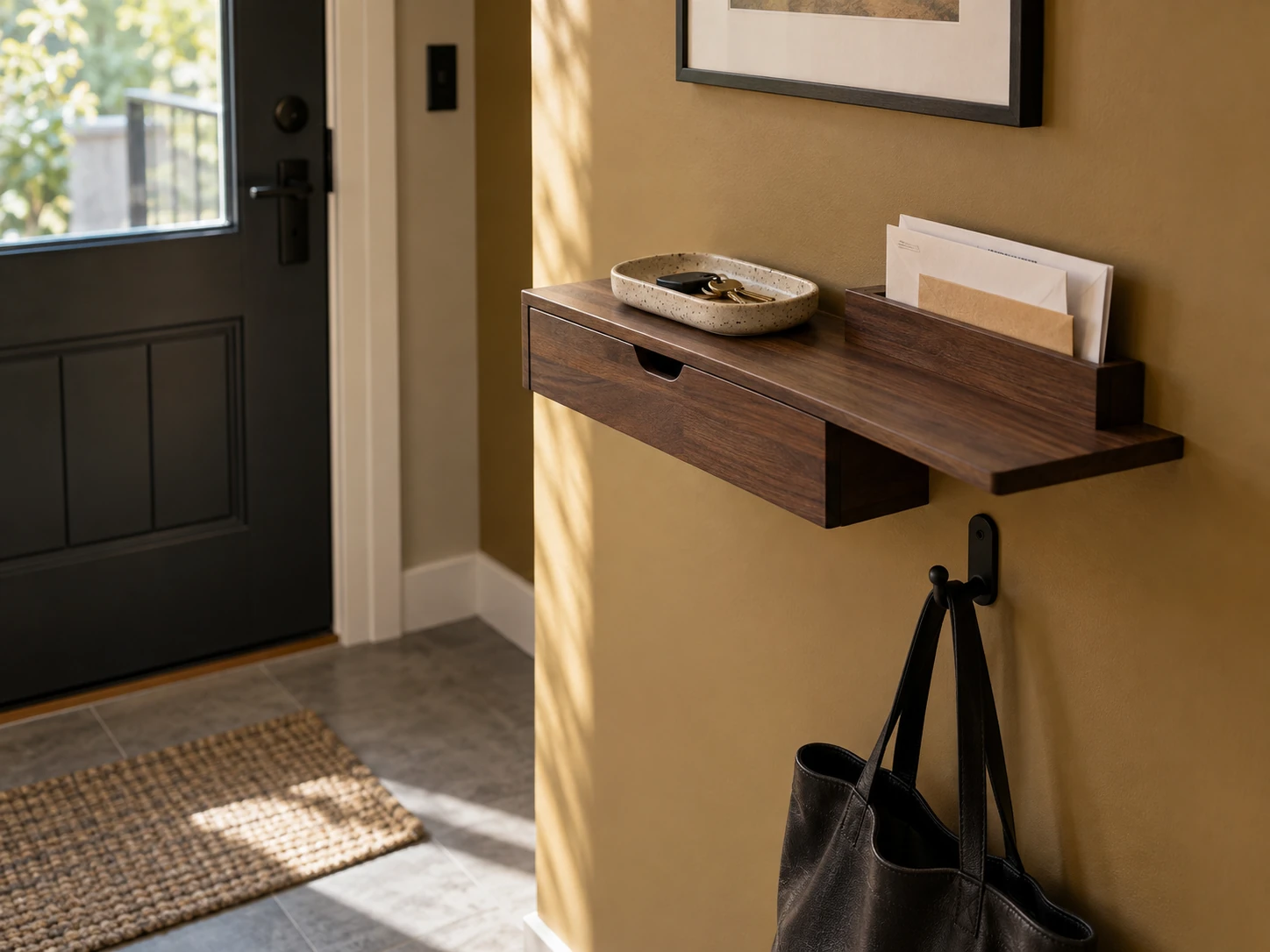
Most small entries become easier to plan when you stop thinking in furniture pieces and think in jobs. You need a landing place, a hanging place, a footwear zone and a visual or lighting anchor. One object can solve more than one job.
A shallow cabinet can provide shoe storage plus a top ledge for keys. A bench can provide seating plus footwear storage. A mirror can add a last-look function and reflect light. Wall hooks can remove the need for a bulky coat stand.
The table below helps choose the smallest combination that completes the routine.
| Entry job | Low-footprint solution | When it works best | Watch for |
|---|---|---|---|
| Drop keys / mail | Small wall shelf, shallow cabinet top or compact tray | The household needs only a landing surface, not deep storage | Surface becoming a permanent paper pile |
| Hang coats / bags | Hooks, rail or compact wall rack | Daily outerwear is limited to an active rotation | Overloading hooks until items project into the route |
| Store shoes | Shallow cabinet, open rack, bench shelf or basket | Only everyday pairs stay at the door | Door swing, ventilation, cleaning and cabinet anchoring |
| Sit to put on shoes | Compact bench or stool | Someone genuinely uses seating daily | Buying a bench that consumes the route but rarely gets used |
| Last look / light | Mirror, wall light or small lamp | The wall can carry a useful visual anchor | Glare, unsafe wiring or a mirror placed where it reflects clutter |
Use wall height before using more floor depth
IKEA’s current small-hallway guidance follows a useful principle: narrow halls benefit from storage that climbs the wall because floor depth is usually the scarce resource. Hooks, rails, shelves and shallow wall storage can handle small categories without adding another deep piece of furniture.
Concentrate vertical storage on one wall when possible. Several unrelated racks and baskets spread around the doorway can make a small entry feel busier than one organized storage zone.
Put frequent items at easy reach and move lighter, lower-frequency categories higher. Anything wall-mounted should be installed according to the manufacturer’s instructions and with fixings suited to the wall construction.
Choose shoe storage from pair count, depth and opening method
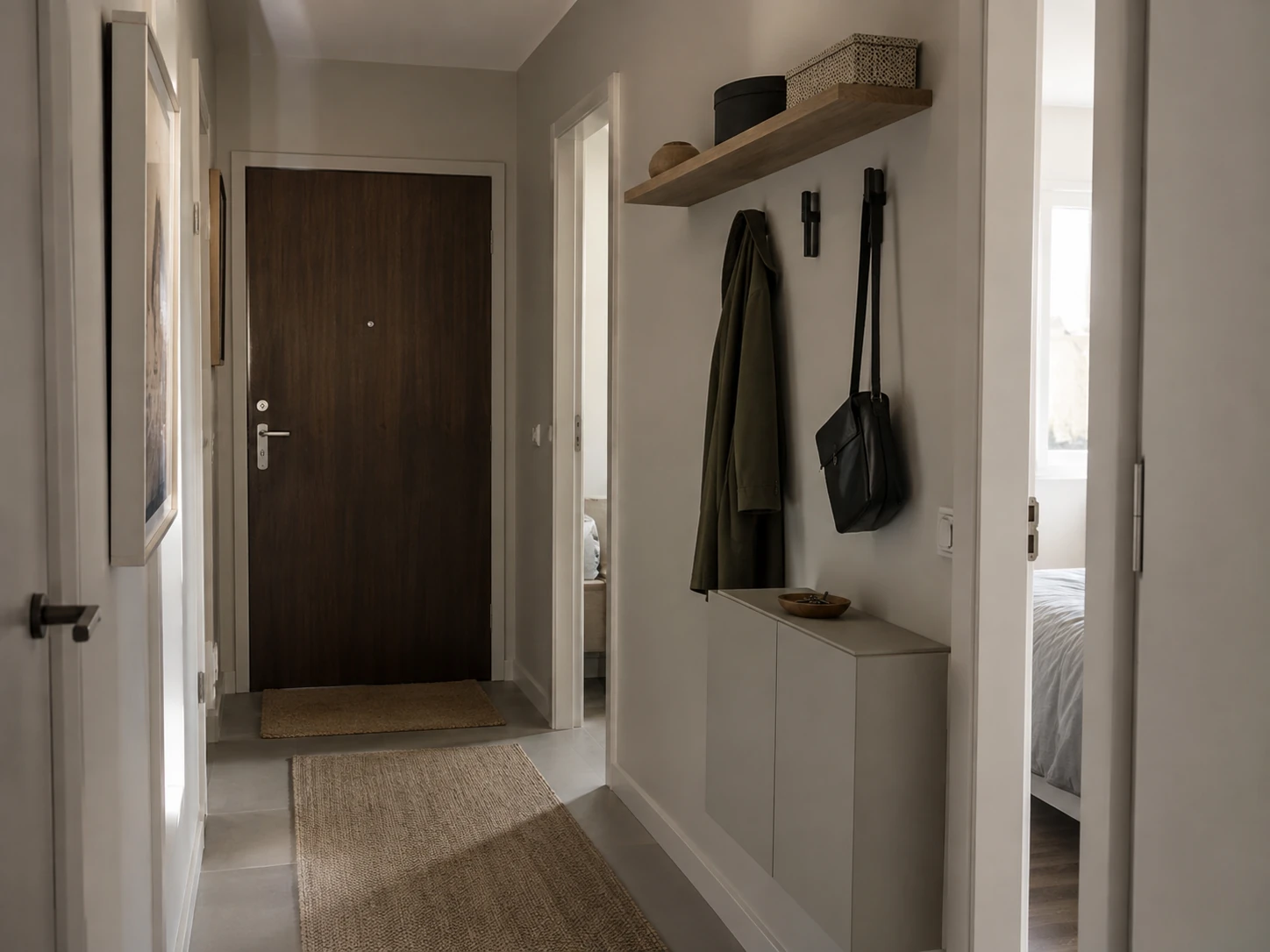
Shoe storage should start with the number of active pairs that really need to stay by the door. A household with two daily pairs needs a different solution from a family whose entry has to manage eight or ten.
Then measure usable depth. Some purpose-built shoe cabinets are remarkably shallow; for example, IKEA currently lists the TRONES shoe/storage cabinet at a little over seven inches deep. That does not make one specific cabinet the answer for every home, but it shows why flip-front or wall-oriented shoe storage can work where conventional shelving would intrude too far.
Open racks make daily shoes easy to grab and allow airflow, but they keep the visual category exposed. Closed cabinets calm the view but require an opening mechanism and regular cleaning. Benches earn their footprint when seating is genuinely useful as well as storage.
Continue with this part of the plan Planned support guide: Small Entryway Shoe StorageA future decision guide comparing cabinets, racks, benches and baskets by footprint, pair count and maintenance.
Read the guide →A narrow console is optional, not the definition of an entryway
Search results make the slim console look mandatory. It is not. A console is useful when you need a landing surface and perhaps a drawer, and the remaining walkway can comfortably absorb its depth.
If there is no floor depth to spare, a wall shelf, shallow shoe cabinet top or small ledge can do the same landing-zone job. If there is already a useful bench, the bench and a wall hook system may eliminate the need for a console entirely.
Buy the console only when it solves a named function. Do not add one because the room does not yet look enough like a Pinterest entryway.
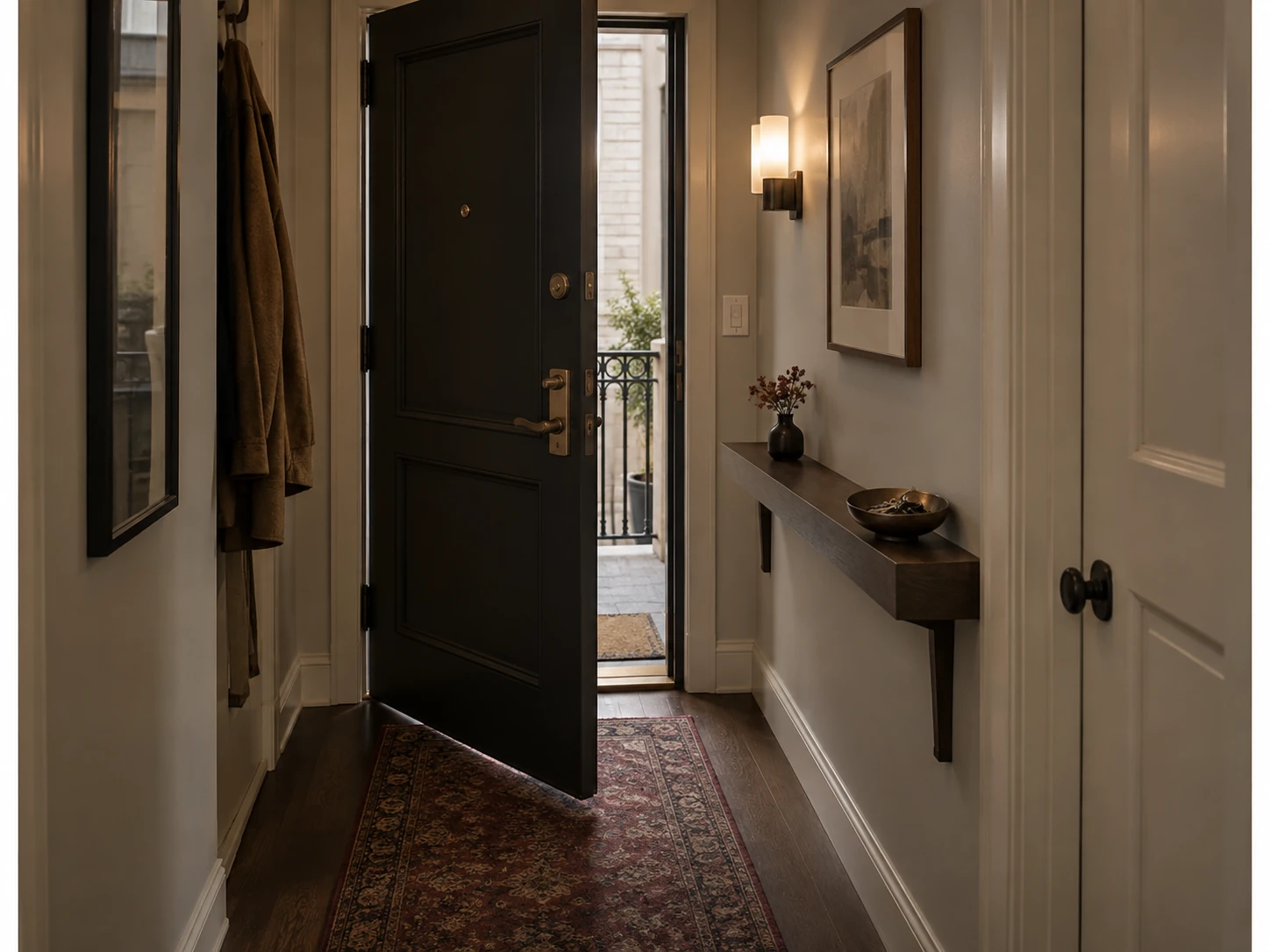
Make hooks specific instead of turning them into a coat mountain
Hooks are powerful because they use the wall, but unlimited hook capacity usually becomes visible clutter. Assign hooks by person or category: daily coat, bag, dog lead, umbrella, reusable tote.
If bulky winter clothing is always by the door, use fewer stronger hooks with enough spacing that garments can hang without swallowing the walkway. If the household has a closet nearby, reserve entry hooks for the active layer only.
Children’s hooks can sit lower where they can actually use them, provided the wall system is installed safely and does not create protrusions in a narrow route.
Use a bench only when sitting is part of the routine
A storage bench is attractive because it promises two functions at once, but it also consumes more floor depth than hooks or shallow shoe storage. In a truly narrow entry, that trade may not be worth it.
A bench earns its footprint when someone regularly sits to put on shoes, children need a landing point, or the storage underneath replaces another piece. Otherwise a compact stool that tucks away, or no seating at all, may make the entry easier to move through.
Measure the bench in use, including knees and any lid or drawer that has to open.
Treat a no-foyer home as a zoning problem
When the front door opens directly into a living room, you do not need to build a fake wall to create a sense of arrival. Use one or two consistent cues: a runner or small rug, a strip of hooks, a shallow landing surface, a mirror or a change in wall treatment.
IKEA’s current “no hallway” guidance similarly uses a compact coat-and-shoe zone to create structure where there is no formal foyer. The useful idea is not the specific product set; it is giving the arrival routine a defined edge.
Keep the visual language connected to the room it opens into so the entry feels intentional rather than like a storage unit parked in the living area.
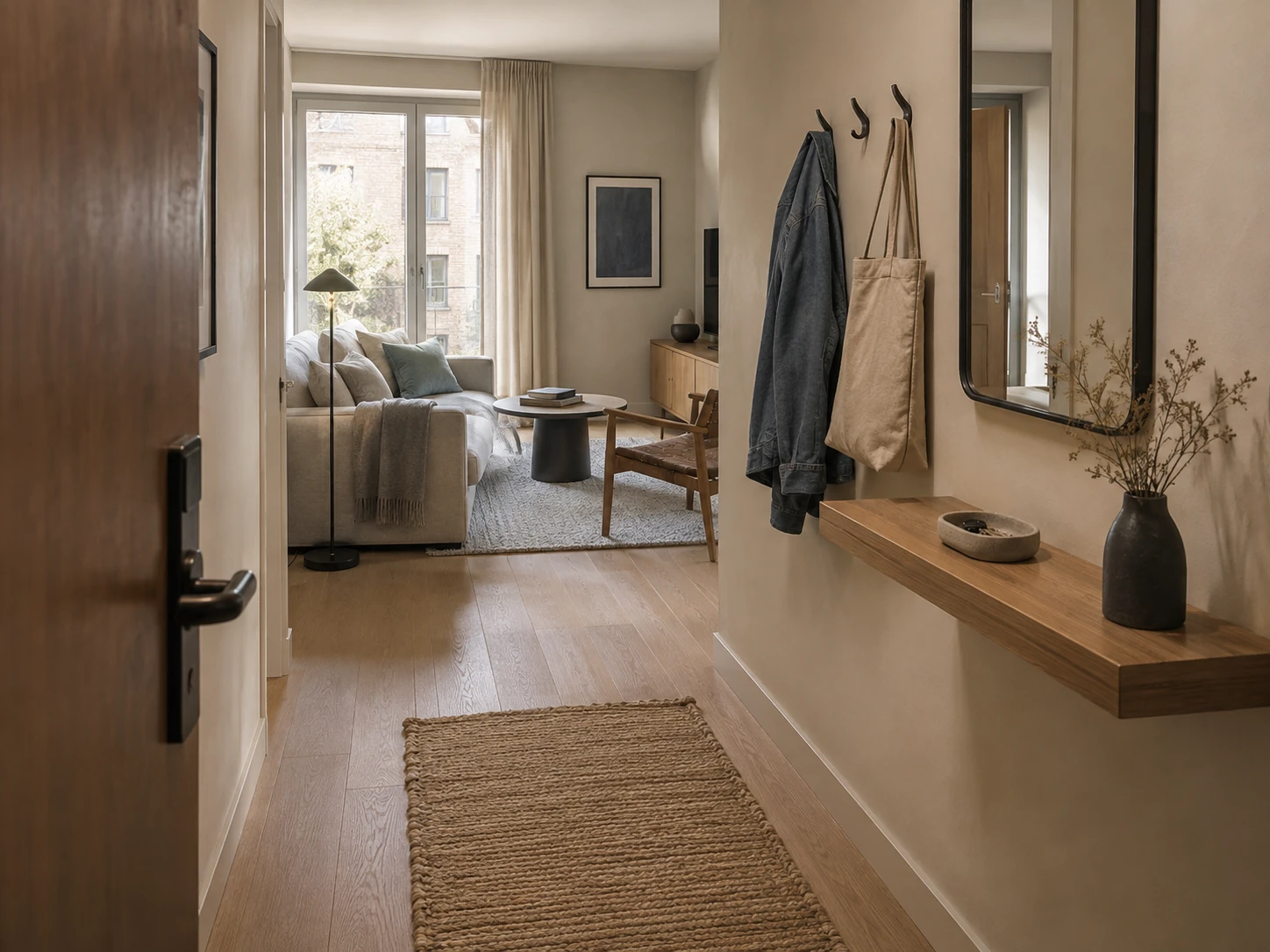
Use a mirror for a job, not because every entryway photo has one
A mirror can provide the last check before leaving and can reflect useful daylight or a pleasant part of the room. That makes it an efficient object in a small entry.
Placement matters. A mirror that reflects an open shoe rack, tangled coats or the brightest bare bulb can double the visual noise instead of making the area feel better.
If the wall would be more useful for hooks or storage, art may be the better anchor. A functional entry does not fail because it lacks a round mirror.
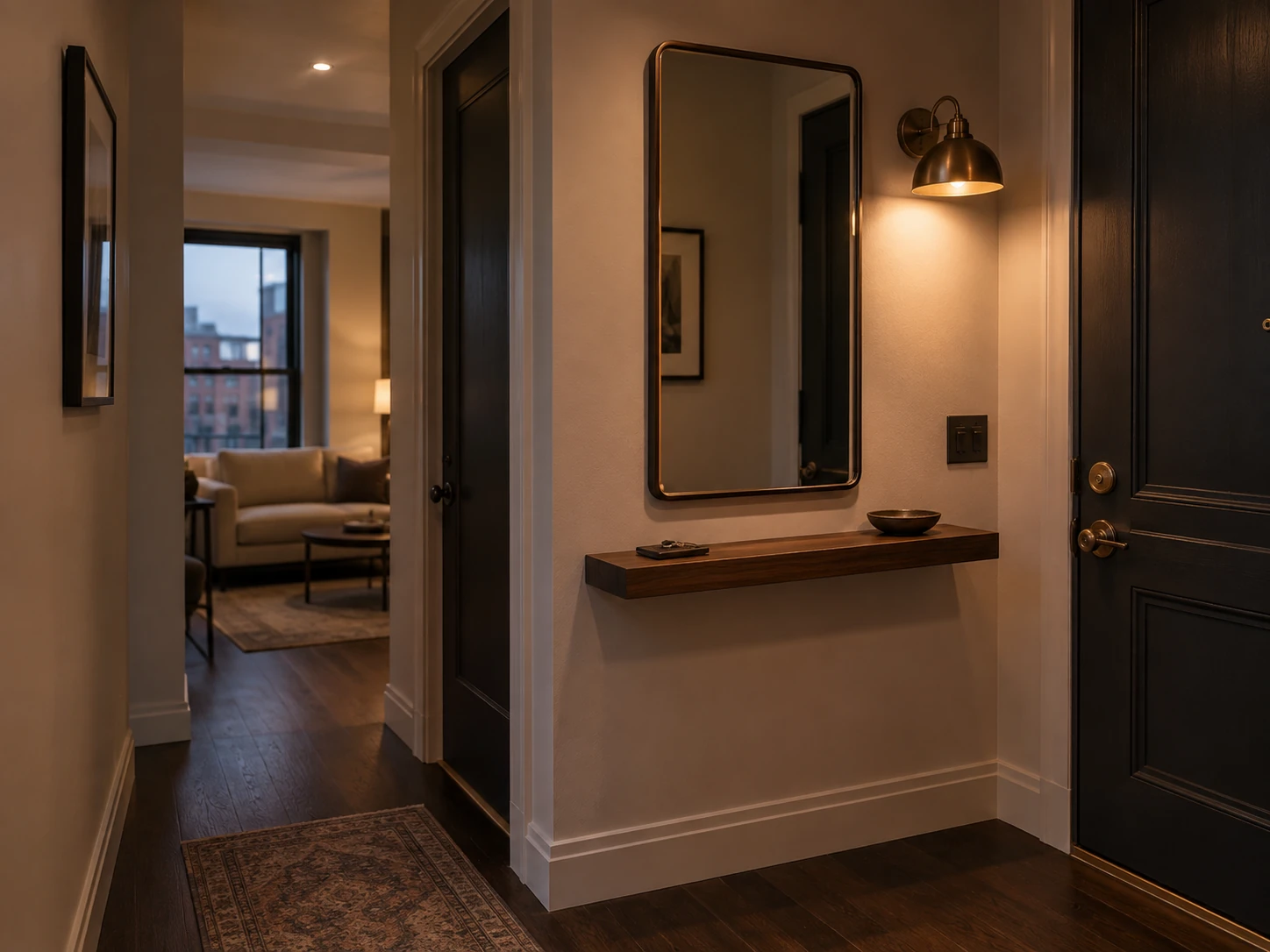
Plan lighting around arrival and departure
The entry needs enough light to see keys, shoes, locks and steps safely. If the ceiling light is adequate for that job, an extra lamp is optional. If the area feels dark or flat, a wall light or compact lamp can add a lower layer without consuming much floor space.
Place switches and controls where the routine makes sense. A beautiful lamp that has to be reached behind a pile of coats is not useful lighting.
For plug-in fixtures, keep cords out of the walking path and follow the product manufacturer’s installation and electrical guidance.
Renter-friendly does not mean attachment-free at any cost
Freestanding racks, baskets, removable trays and furniture that moves with you are natural renter options. But tall or top-heavy storage may still require anchoring for safe use, and some wall-mounted products are designed to be mechanically fixed.
Do not substitute adhesive strips for required structural fixings. Where anchoring is required, check the lease and discuss an approved installation method rather than leaving unstable furniture unsecured.
Prioritize systems that can move to the next home: adjustable rails, modular shoe storage, baskets and small freestanding pieces are usually easier to reuse than highly custom entry built-ins.
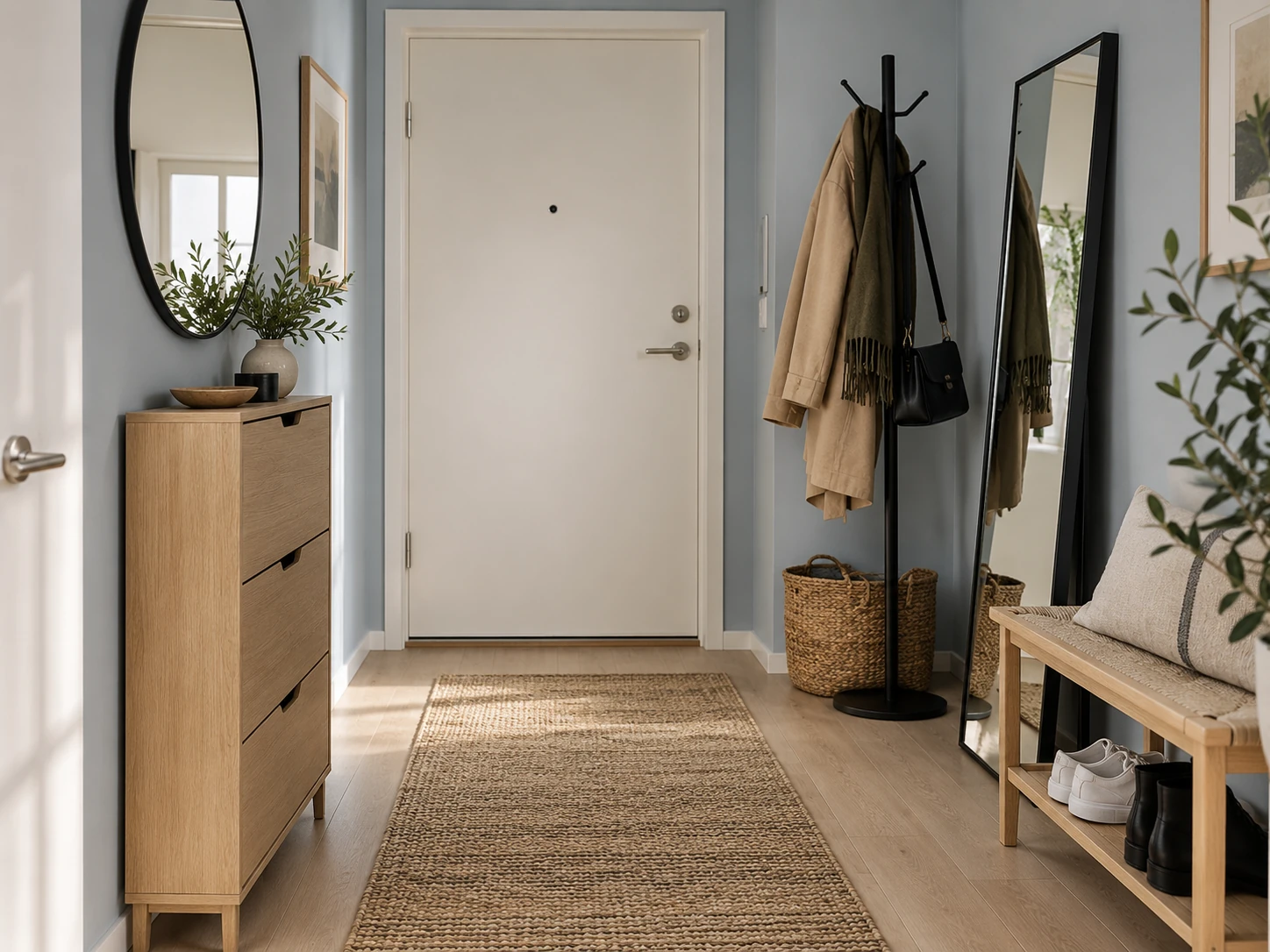
Protect the floor and the cleaning routine
Entryways receive outdoor dirt, water and grit before the rest of the home does. Choose a mat or runner that fits the actual door clearance and is easy to clean for the climate and household.
Leave enough access to vacuum or mop around the shoe zone. Storage that traps dirt behind a fixed base or requires moving several baskets every time the floor is cleaned often becomes a maintenance problem.
If wet shoes are common, provide a washable or wipeable landing zone rather than relying on decorative baskets that are difficult to clean.
Run the five-minute entryway test
Before ordering furniture, tape the footprints onto the floor and live through the routine. Open the front door fully. Enter carrying a bag. Put down keys. Take off shoes. Hang a coat. Walk into the home. Then reverse the process as if you are leaving in a hurry.
If any step requires moving another object first, the storage plan is too complicated. If shoes land on the floor even though a cabinet exists, the cabinet may be too inconvenient for daily use.
The best small entryway is not the one with the most storage. It is the one that makes the arrival and departure routine obvious enough that clutter has fewer chances to begin.
- Front door opens fully without furniture conflict.
- The main walking route remains clear when shoes and bags are in use.
- Everyday shoes have one defined home.
- Daily coats and bags have an easy hanging point.
- Keys and small carry items have a landing surface or tray.
- Storage depth is measured from the wall to the furthest projection, including handles.
- Cabinet doors, drawers and bench lids can open fully.
- Wall-mounted and tall storage can be installed as the manufacturer requires.
- The floor around the shoe zone can be cleaned easily.
- The entry can be reset in a few minutes.
Keep the visual summary.
This is the condensed version of the guide, useful when you are planning, comparing options or returning to the key decisions later.
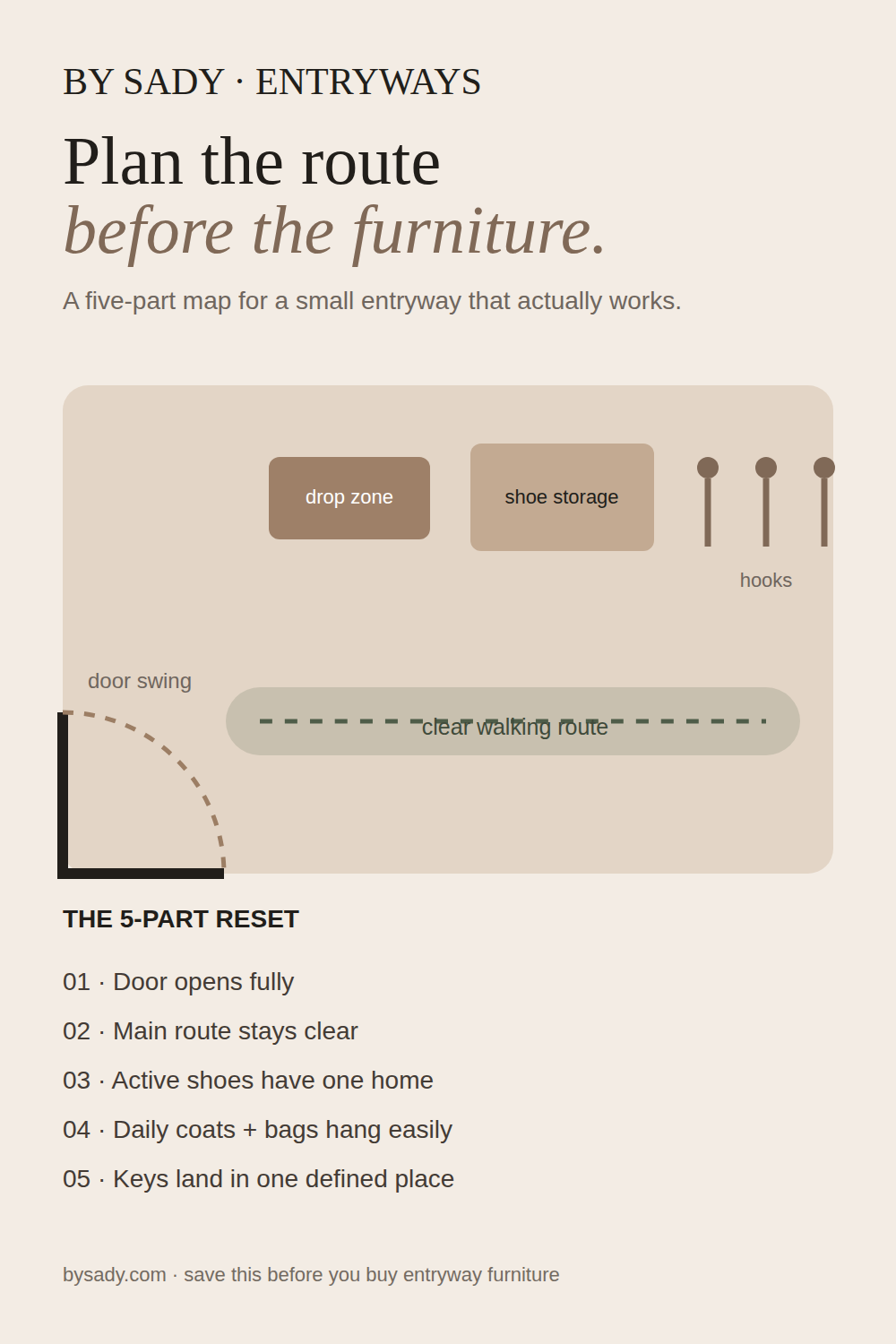
Where the measurable guidance comes from
By Sady's styling advice is editorial. Where this guide uses measurements or specific planning guidance, these are the references used. Always measure your own room and follow local electrical and building requirements.
- IKEA U.S.: A small hallway with plenty of clever storage ideas
Current reference for narrow shoe storage, wall-based organization and using vertical space in a compact hallway.
- IKEA U.S.: No hallway? No problem
Current reference for creating a functional arrival zone where a home has no dedicated foyer.
- IKEA U.S.: TRONES shoe/storage cabinet
Manufacturer reference for a current shallow shoe-storage example and its dimensions.
- U.S. CPSC: Anchor It!
Primary safety reference for securing top-heavy furniture and following appropriate anchoring guidance.
Relevant finds from this guide.
HOOBRO 29.5-Inch Narrow Console Table
Slim entryway console table for a small landing surface and modest decor.
Command Medium Designer Hooks
Small removable adhesive hooks for lightweight entryway accessories on compatible indoor surfaces.
Simple Houseware 24-Pocket Over-the-Door Organizer
Clear hanging pockets for shoes and light miscellaneous storage behind a compatible door.
Explore focused guides for this topic.
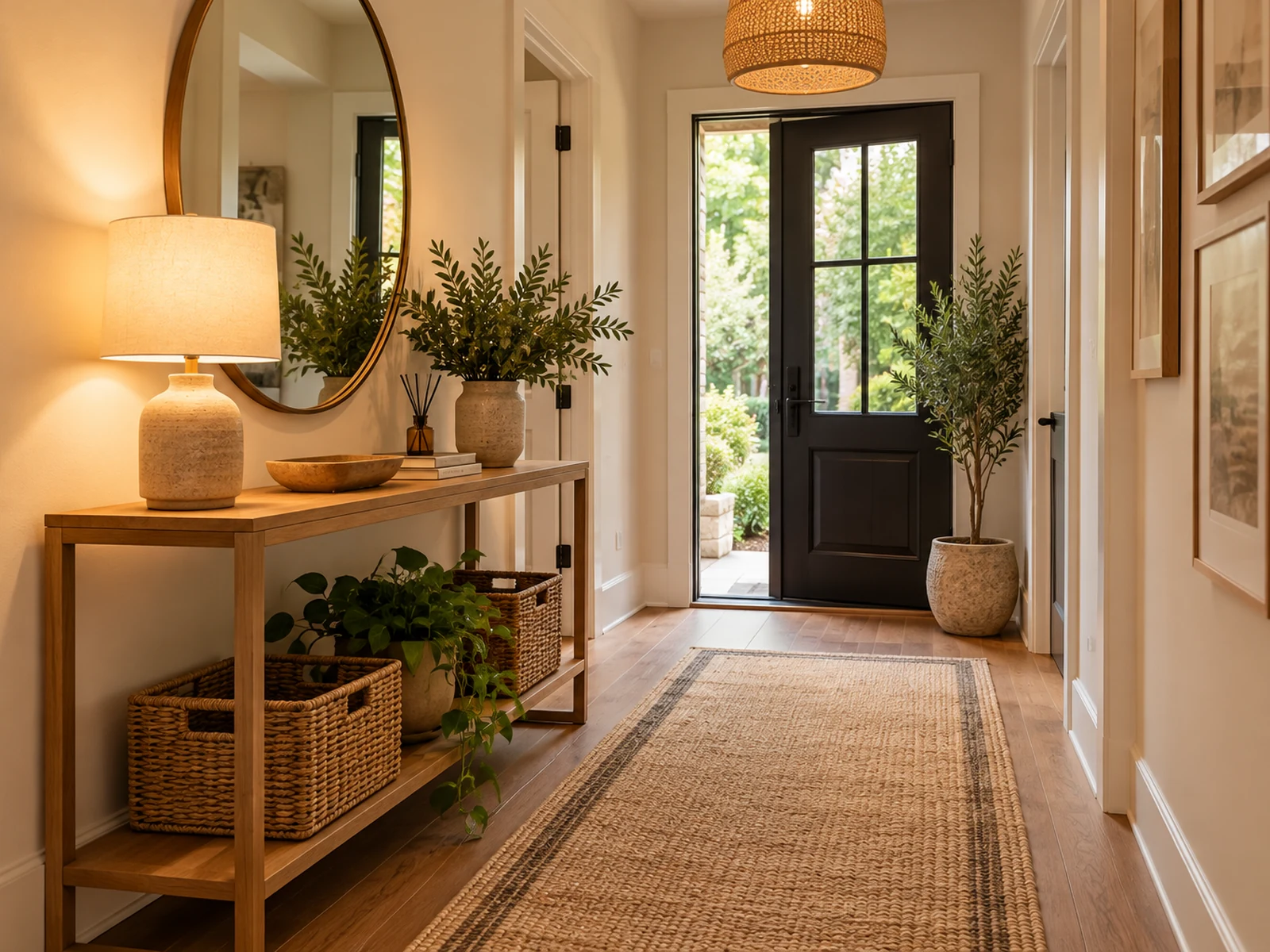
Entryway Lighting Ideas for Small Spaces: Light the Door, Mirror and Drop Zone
A compact entryway lighting plan built around the door, mirror, key-and-mail drop zone and safe circulation rather than adding decorative fixtures to every surface.
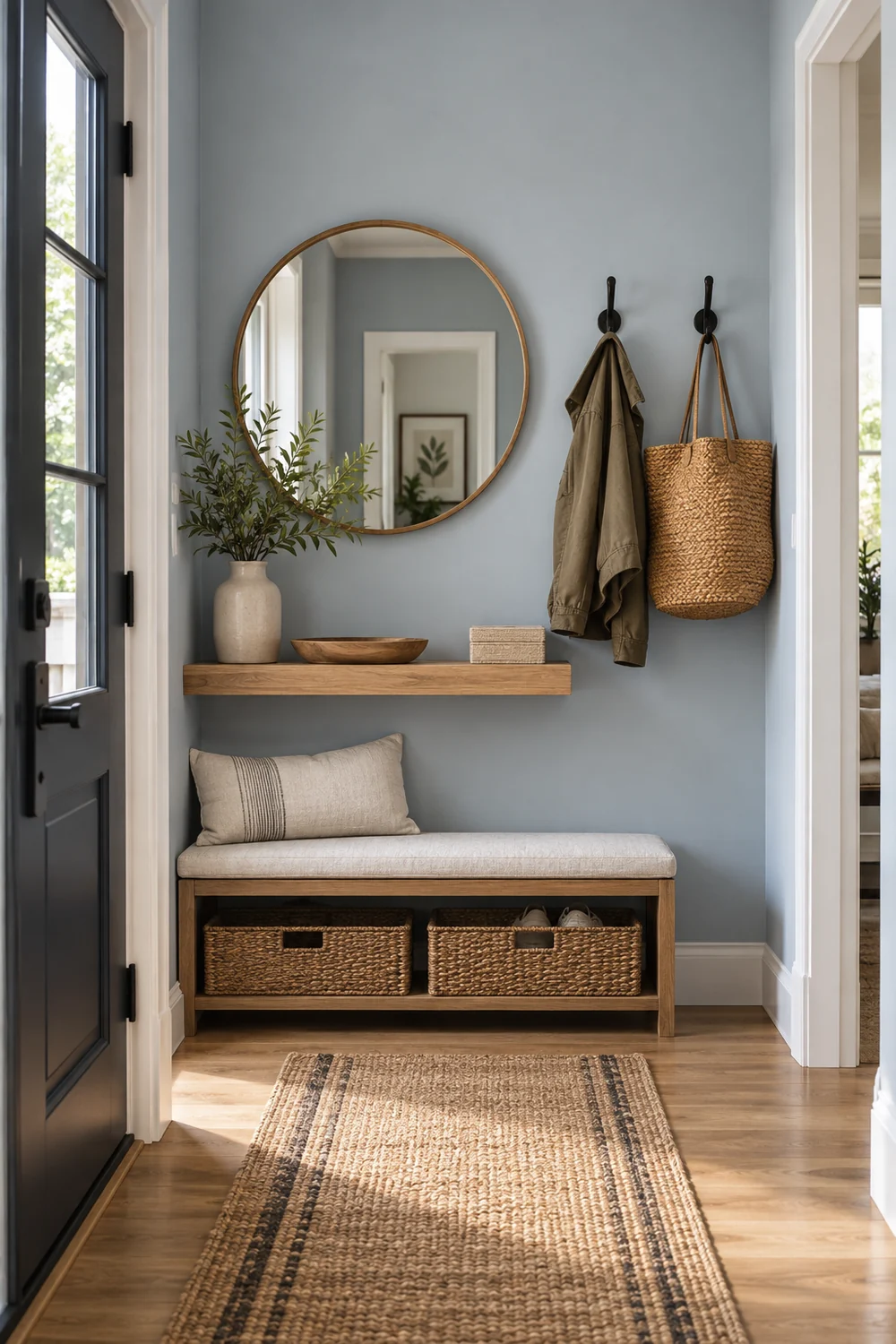
Small Entryway Measurement Checklist Before You Buy Storage or a Console
A saveable measurement checklist for compact entryways covering door swing, walking route, console depth, shoe storage opening, mirror zone, hooks, switches, outlets and trim.
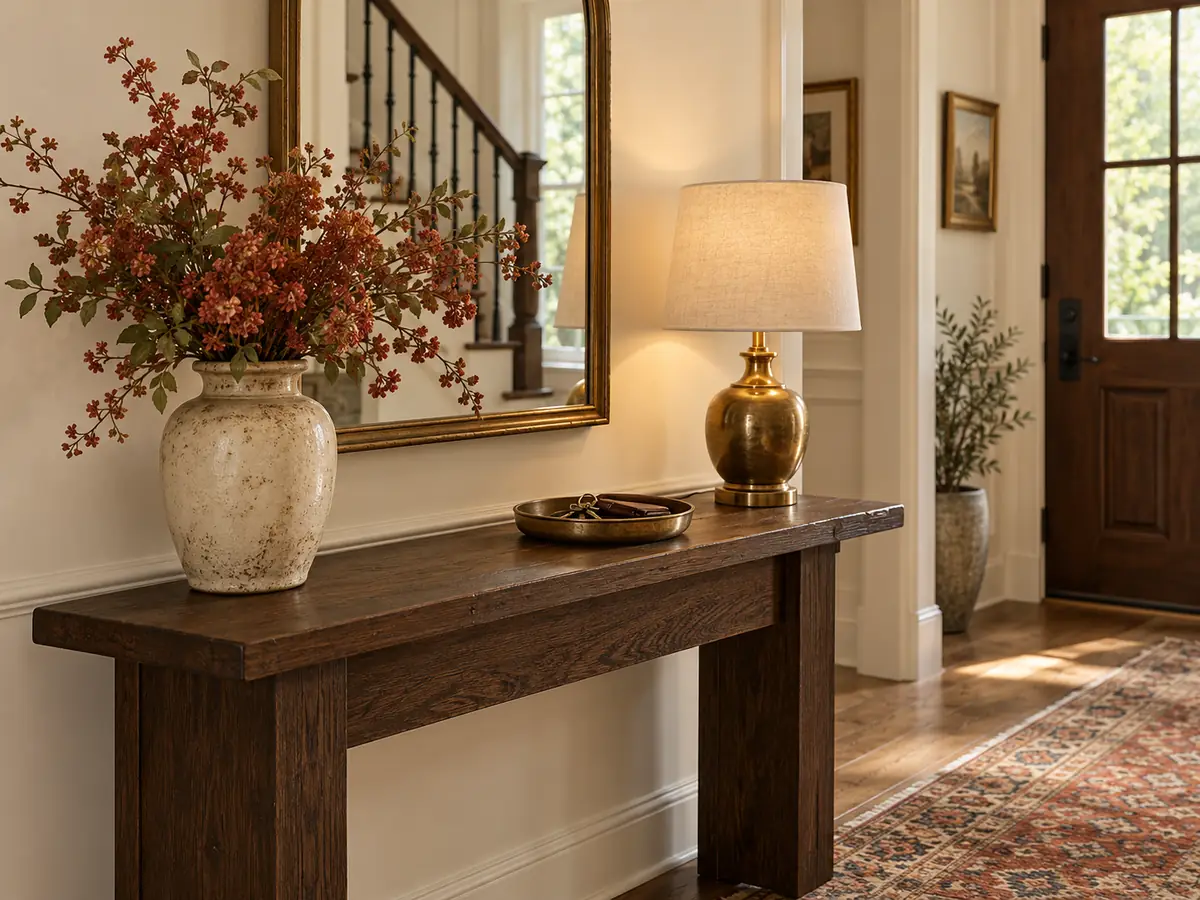
Console Table Styling for Small Entryways: A Formula That Still Leaves Useful Space
A practical styling formula for small entryway consoles that keeps a real key-and-mail landing zone while adding a vertical anchor, light and one contained accent.
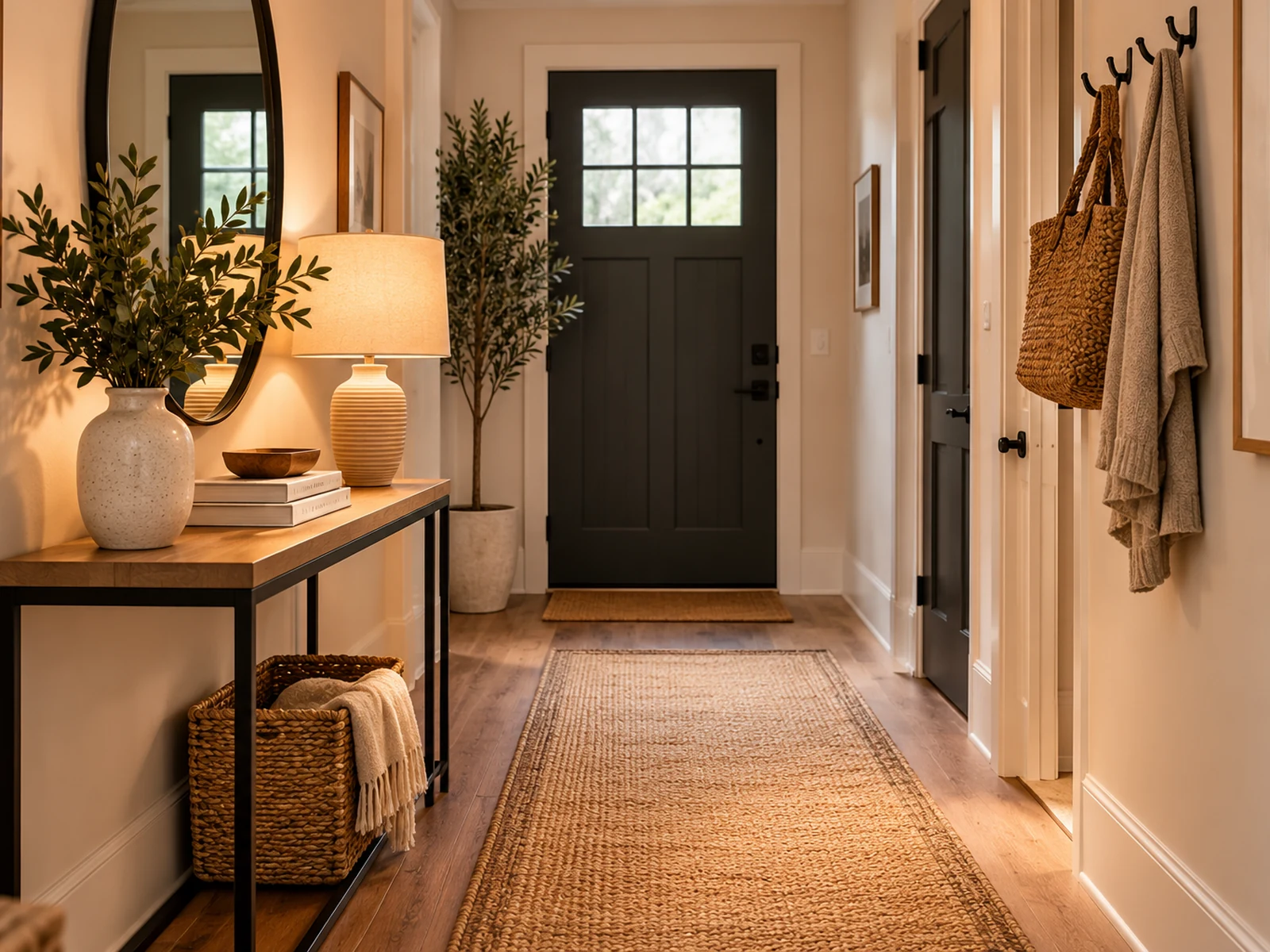
Narrow Entryway Console Guide: Depth, Door Clearance and Storage Before Style
A measurement-first guide to narrow entryway consoles, covering usable wall depth, door swing, drawer opening, walking route, storage jobs and furniture stability before styling.
More from Entryways.
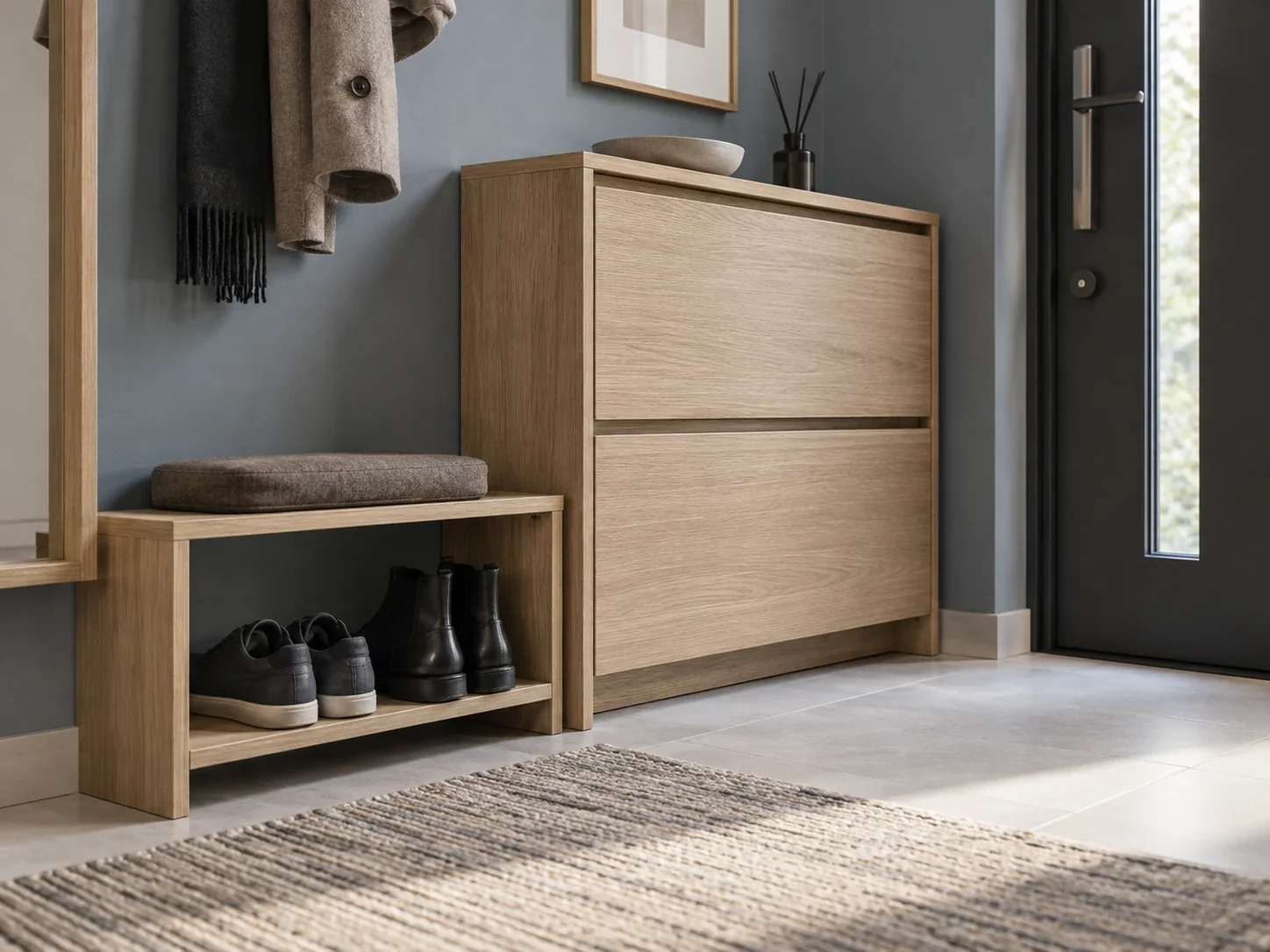
Small Entryway Shoe Storage: How to Choose a Cabinet, Rack, Bench or Basket
A practical shoe-storage decision guide for narrow halls and small foyers, comparing shallow cabinets, open racks, benches and baskets by pair count, depth, door swing, cleaning and daily use.
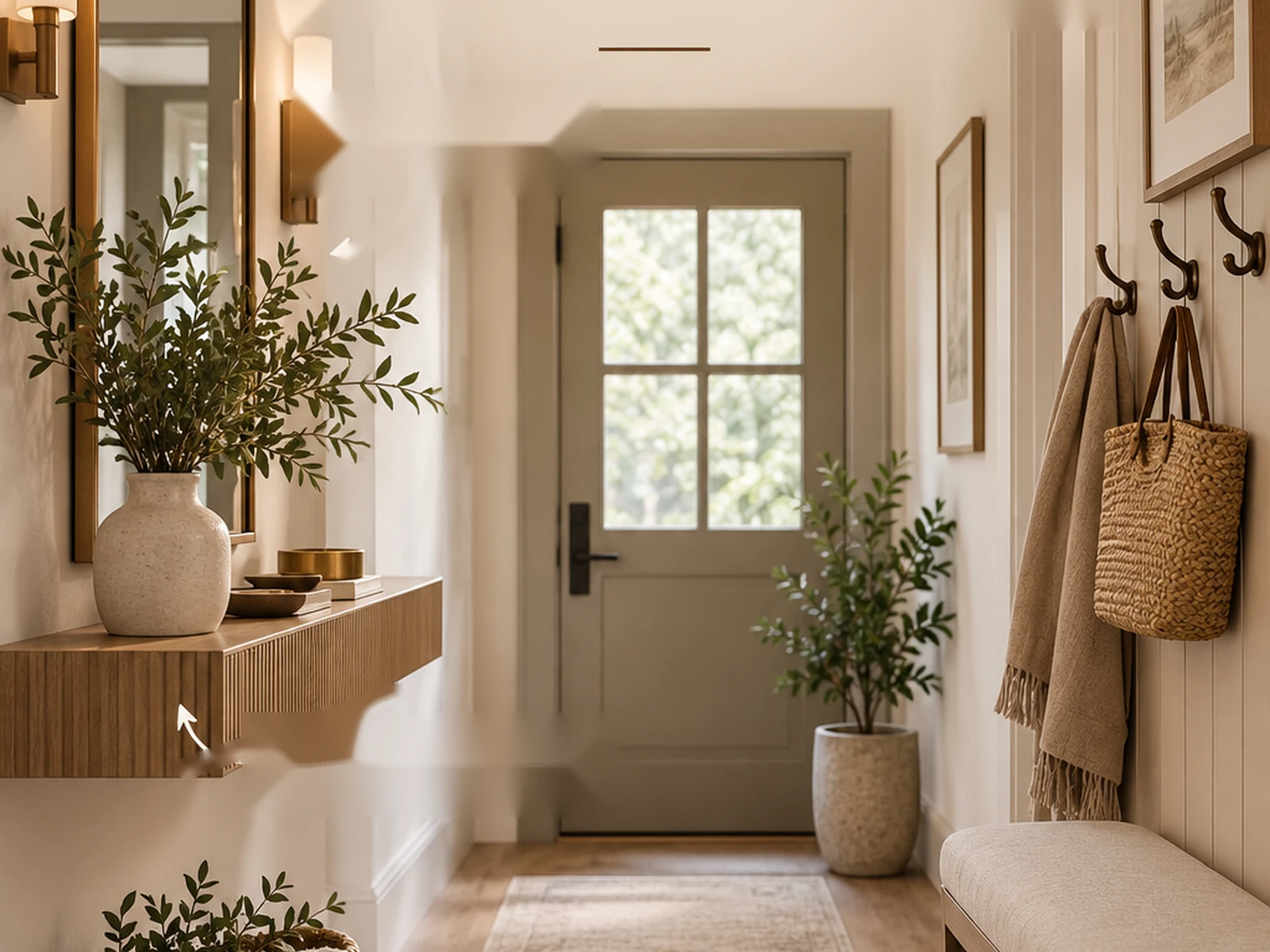
Entryway Mirror Ideas for Small Spaces
A practical guide to entryway mirror size, placement, reflection, console pairing, lighting and mounting in compact halls and no-foyer homes.
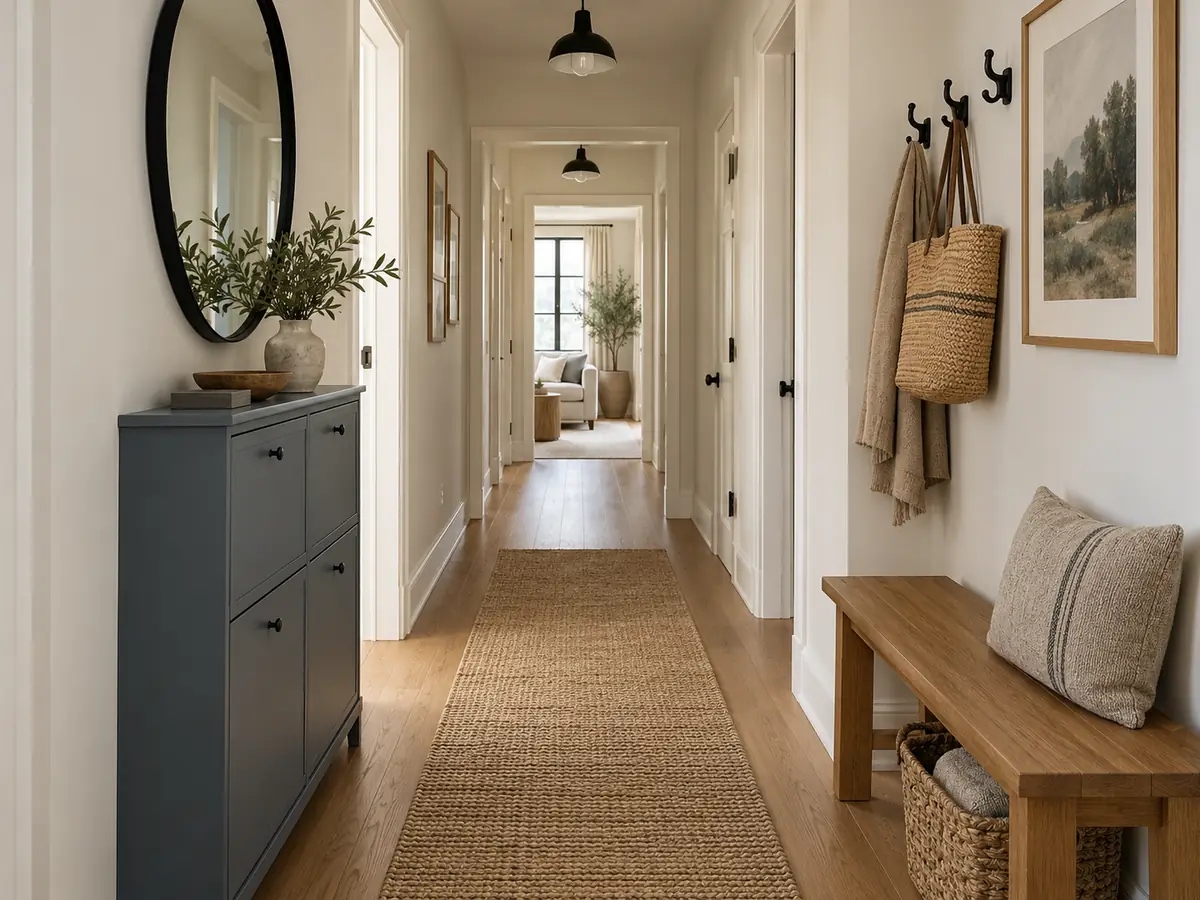
Entryway Wall Ideas for Small Spaces: Hooks, Art, Mirrors and Useful Storage
A wall-planning guide for compact entryways that prioritizes mirror, hooks, shallow storage, art and lighting without making one narrow wall do every possible job.