
Small Living Room Storage Ideas: What to Hide, Display and Put on the Wall
A practical storage guide for compact living rooms, covering open versus closed storage, media units, toys, books, multifunctional furniture, wall height, renters and furniture safety.
Small living-room storage fails when everything is treated as either display or clutter. The useful system decides what should be visible, hidden, easy to reach and moved somewhere else.
Part of the By Sady guide Small Living Room Ideas →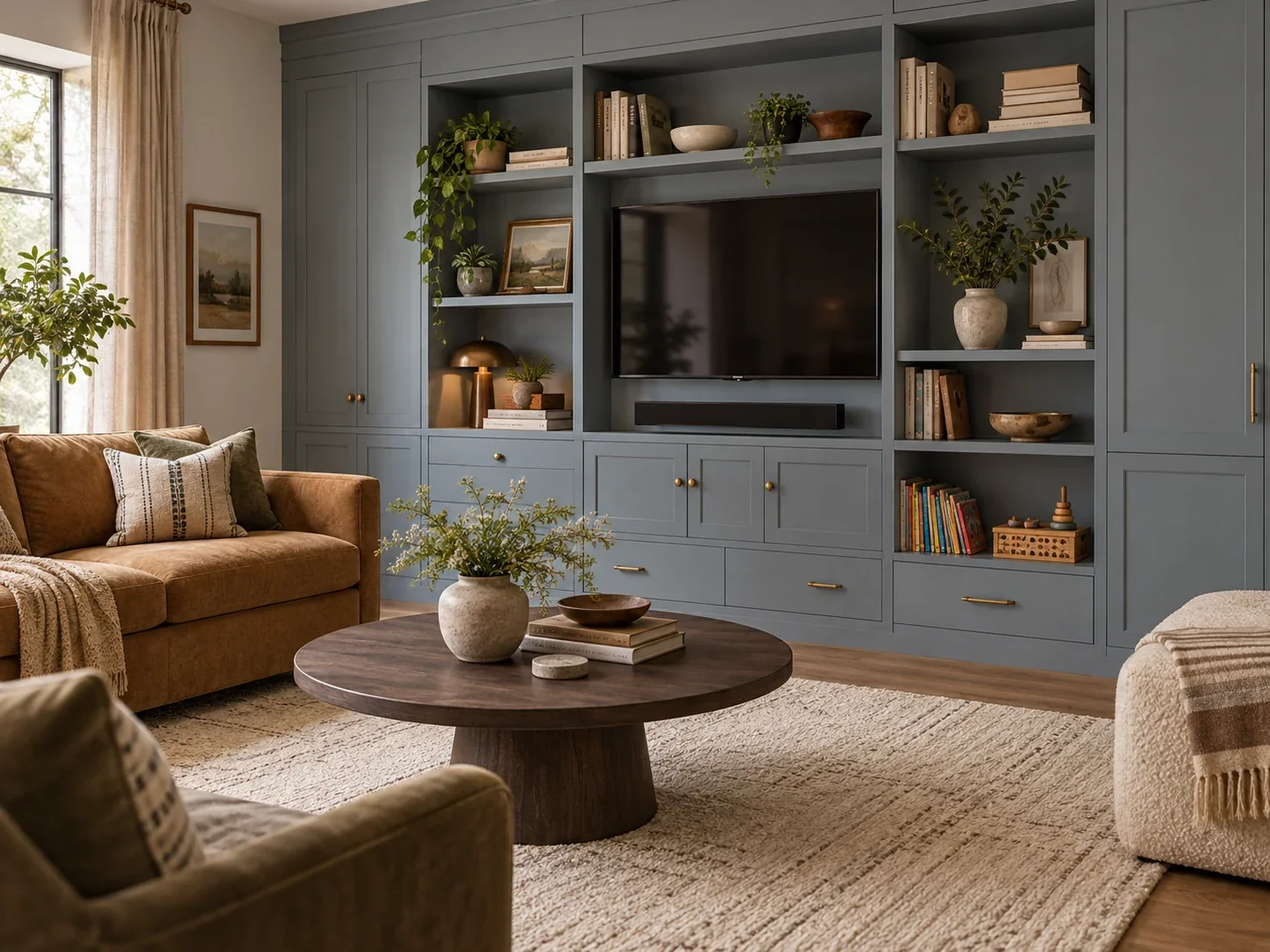
What matters most
- 01
Sort living-room belongings by access frequency and visual noise before buying storage.
- 02
Use closed storage for high-count or visually mixed categories and open storage for edited, frequently used objects.
- 03
Concentrate storage into one or two zones rather than placing small cabinets around every wall.
- 04
Let media storage, seating and tables earn their footprint by solving more than one real job.
- 05
Anchor TVs and top-heavy furniture according to current manufacturer and CPSC safety guidance.
Do a living-room inventory before you buy another cabinet
The living room often becomes the overflow room because it sits at the center of daily life. Books, chargers, toys, games, blankets, paperwork, exercise gear and media all arrive there even when the room was never designed to store them.
Write down the categories that genuinely need to live in the room and divide them by frequency: daily, weekly and occasional. Then mark each category as visually calm or visually noisy. A small row of books can be attractive in the open; a mix of cables, toys and paperwork usually creates a calmer room behind a door or drawer.
This turns storage from a furniture-shopping exercise into a placement problem. You are choosing where a known category belongs, not buying a cabinet and hoping it creates order.
Use open, closed and hidden storage for different jobs
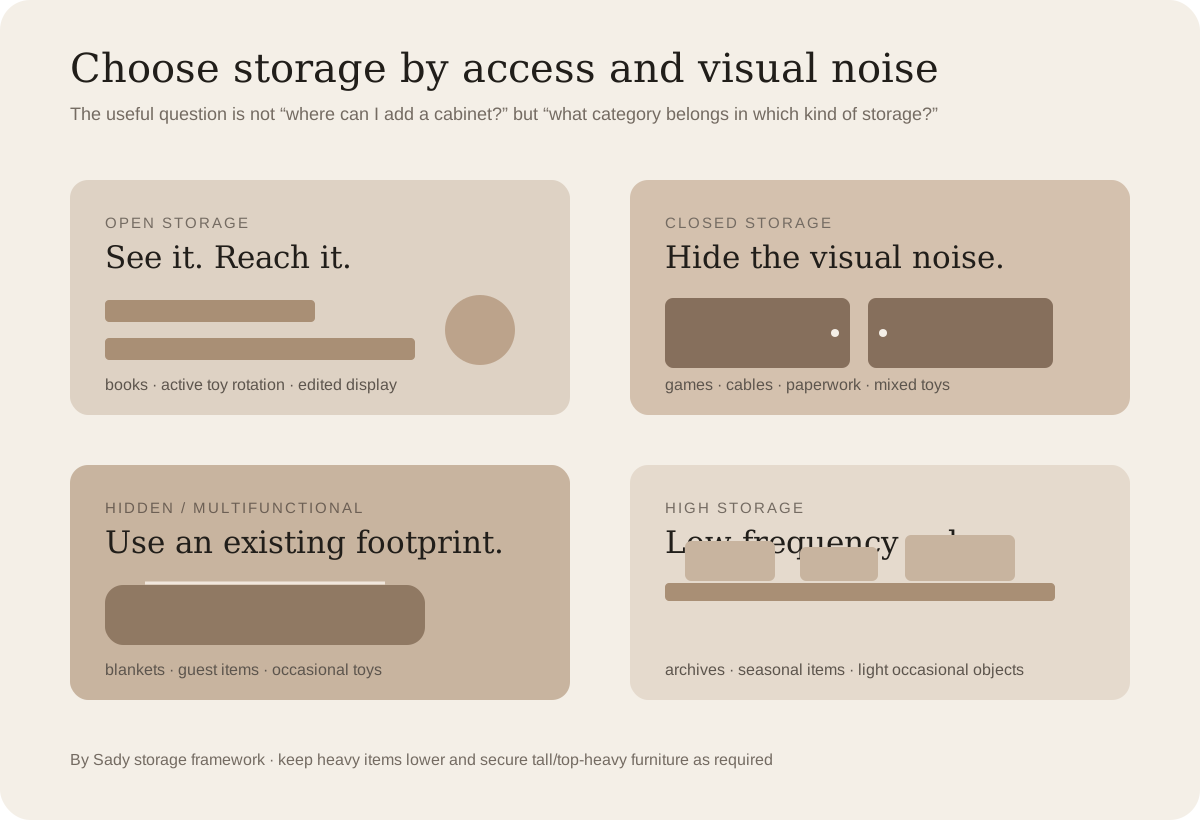
IKEA’s current compact-living examples deliberately mix open, closed and hidden storage rather than treating one format as universally better. That is the more useful model for a small room.
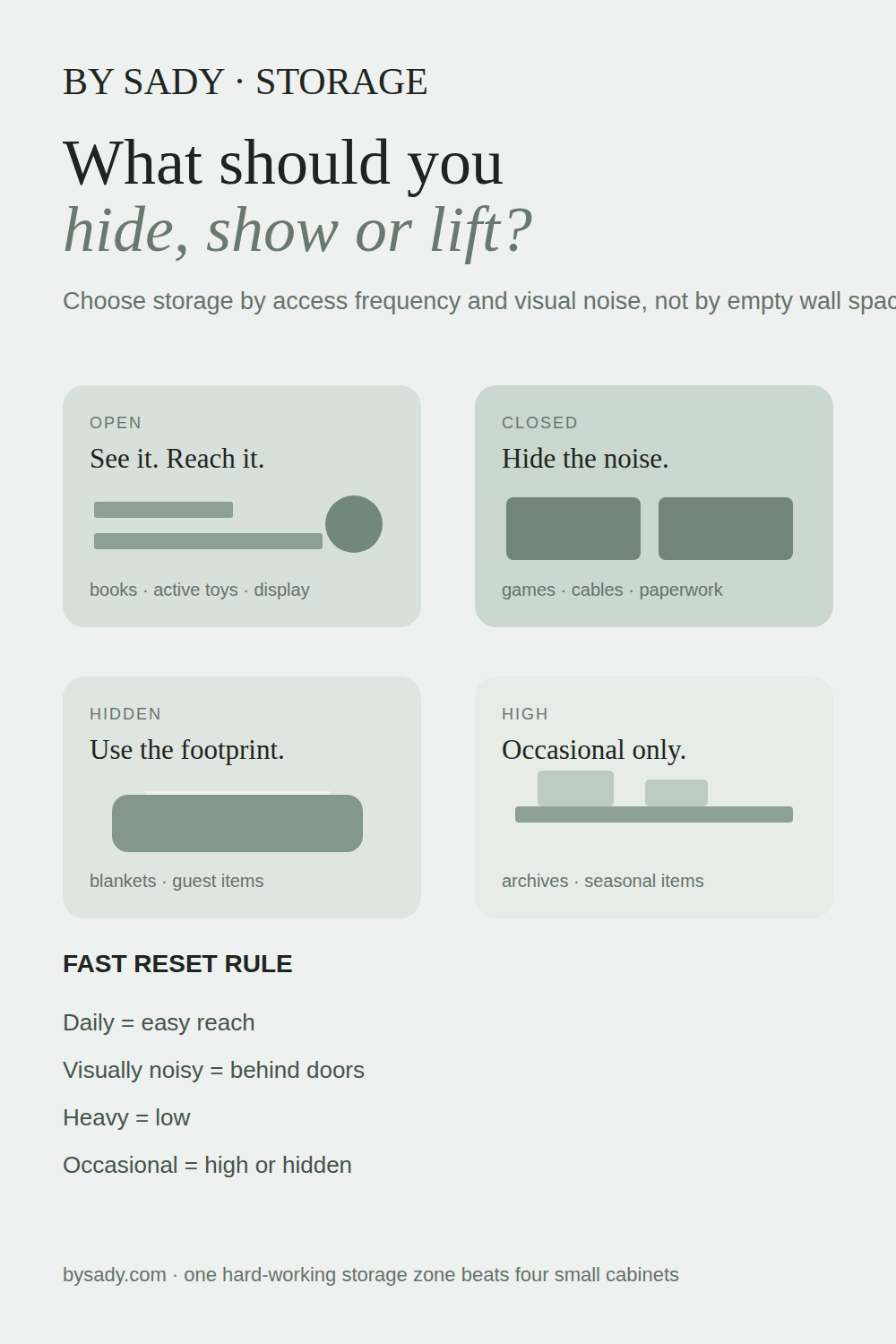
Open storage is best for things you need to see or reach easily and for a deliberately edited display. Closed storage is better for categories with many small pieces, mixed packaging or visual clutter. Hidden storage inside seating or behind another object is useful for lower-frequency items when it does not make access awkward.
The room becomes easier to reset when each format has a job instead of every shelf trying to be both display and warehouse.
| Storage format | Best for | Main strength | Watch for |
|---|---|---|---|
| Open shelves | Books, a small toy rotation, attractive objects, frequently used media | Fast access and visual lightness | Too many mixed categories become visual noise |
| Closed cabinets | Games, paperwork, electronics, mixed toys, backup supplies | Calm appearance and easier visual reset | Deep cabinets can hide clutter instead of organizing it |
| Drawers | Chargers, controllers, stationery, small everyday items | Easy access to small categories | Drawer depth and pull-out zone |
| Hidden seat/table storage | Blankets, occasional toys, guest items | Uses an existing furniture footprint | Heavy lids, deep bins and hard-to-reach contents |
| High storage | Archives, seasonal items, low-frequency objects | Uses wall height instead of floor area | Reach, weight and safe installation |
Concentrate the storage instead of ringing the room with furniture
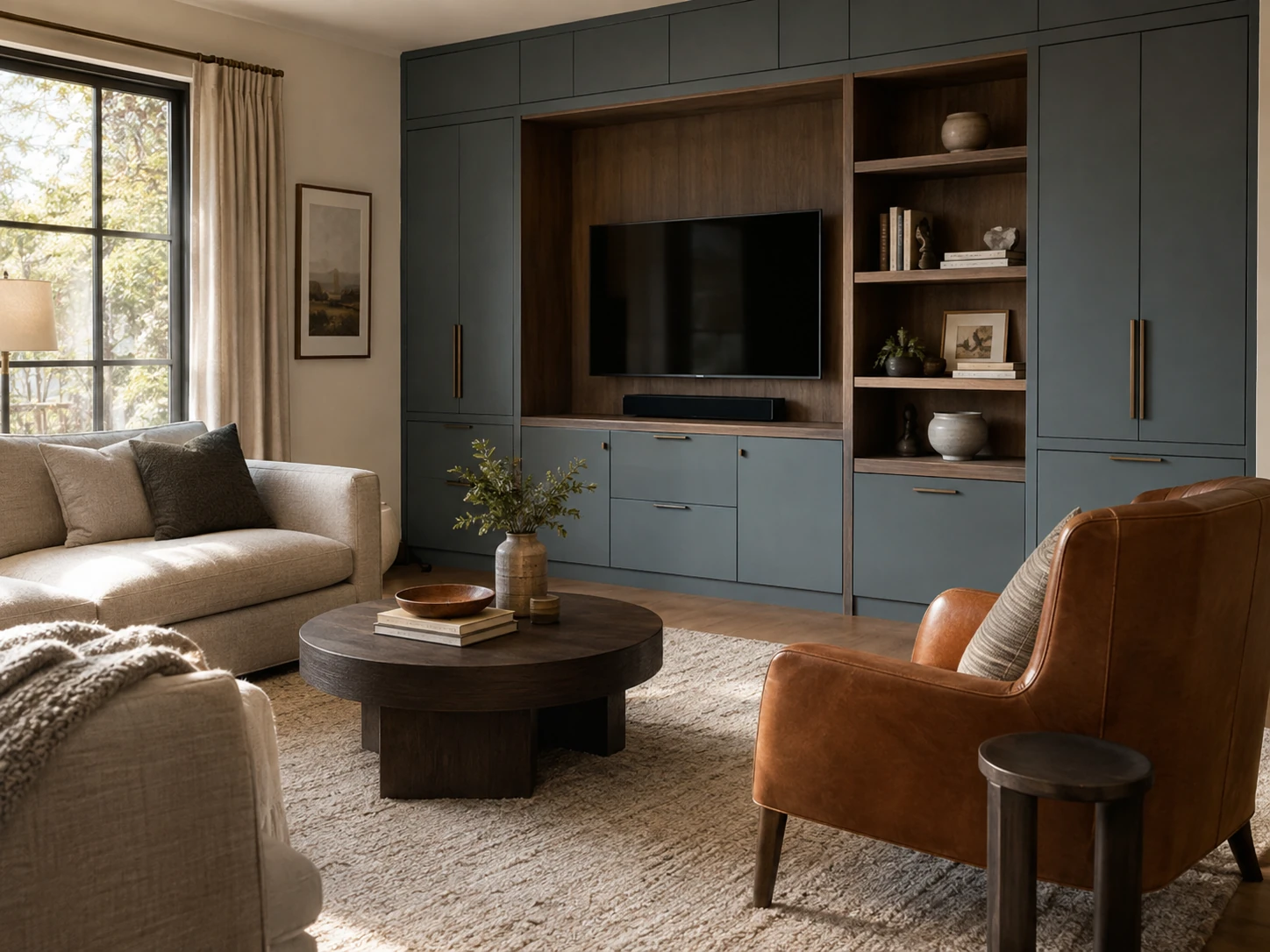
A small sideboard on one wall, a bookcase on another, baskets by the sofa and a media unit opposite can consume more perimeter and create more visual breaks than one stronger storage zone.
IKEA’s current small-living-room examples repeatedly use coordinated open-and-closed units or a storage wall to organize several categories in one place. The transferable principle is concentration, not copying a particular system.
Choose the wall with the fewest interruptions and decide how much storage it can carry without constricting the route. Then let other walls breathe.
Build media storage around the equipment you actually own
A TV wall can become a useful storage zone because the screen already claims visual attention. Cabinets below, beside or above it can consolidate games, controllers, cables, books and household items.
Do not automatically build a giant media wall around a small television. Start with the equipment count, ventilation needs, cable routes and the storage categories that genuinely need to stay nearby.
CPSC advises placing TVs on furniture designed to support them and securing TVs and furniture against tip-over. If a flat-screen is wall-mounted, follow the TV and mount manufacturers’ instructions. Keep cords controlled and avoid placing tempting objects high on furniture where children may climb to reach them.
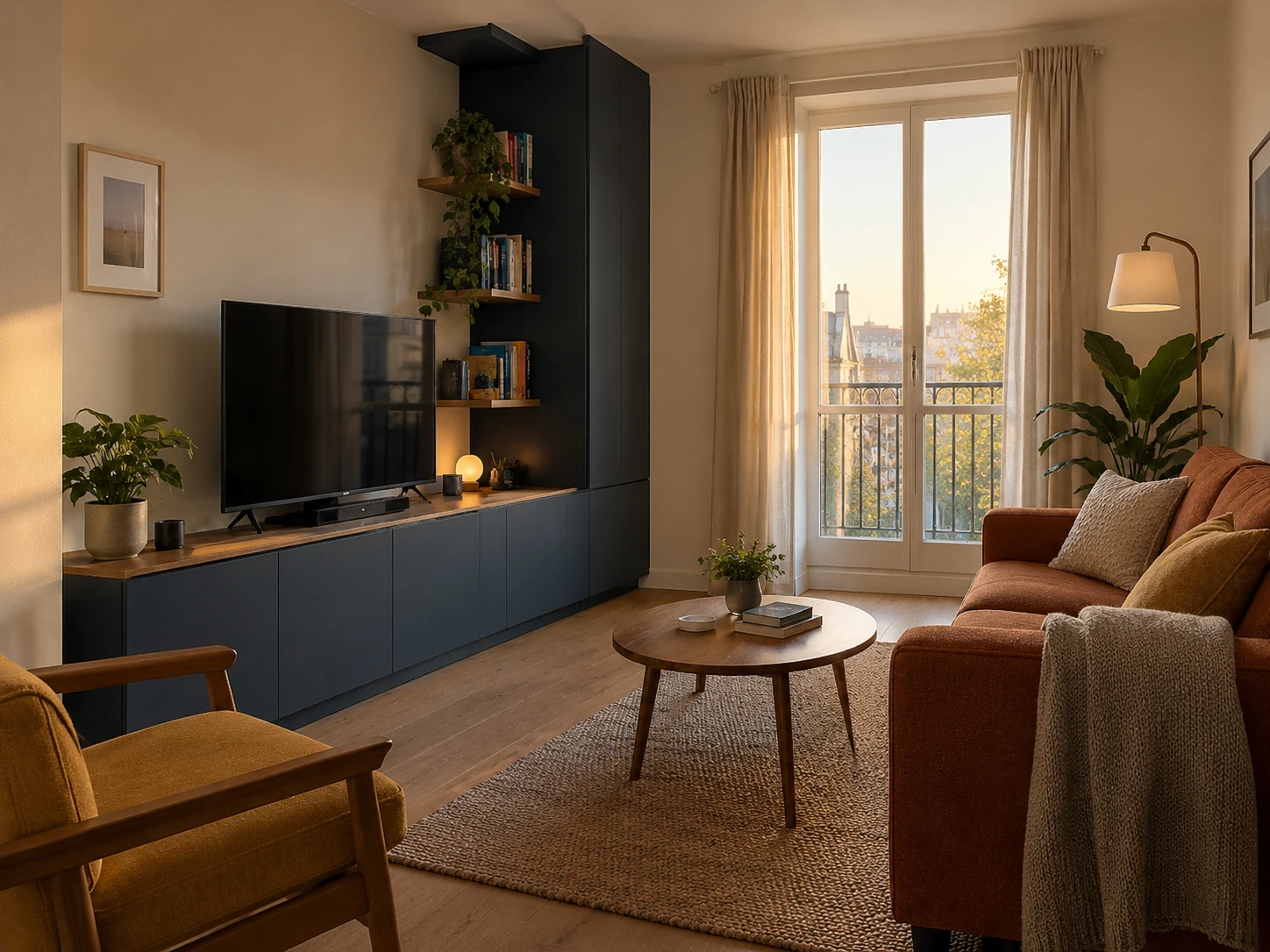
Make sure media storage supports the room’s route and seating plan rather than dictating them.
Read the guide →For toys, accessibility and visual calm can coexist
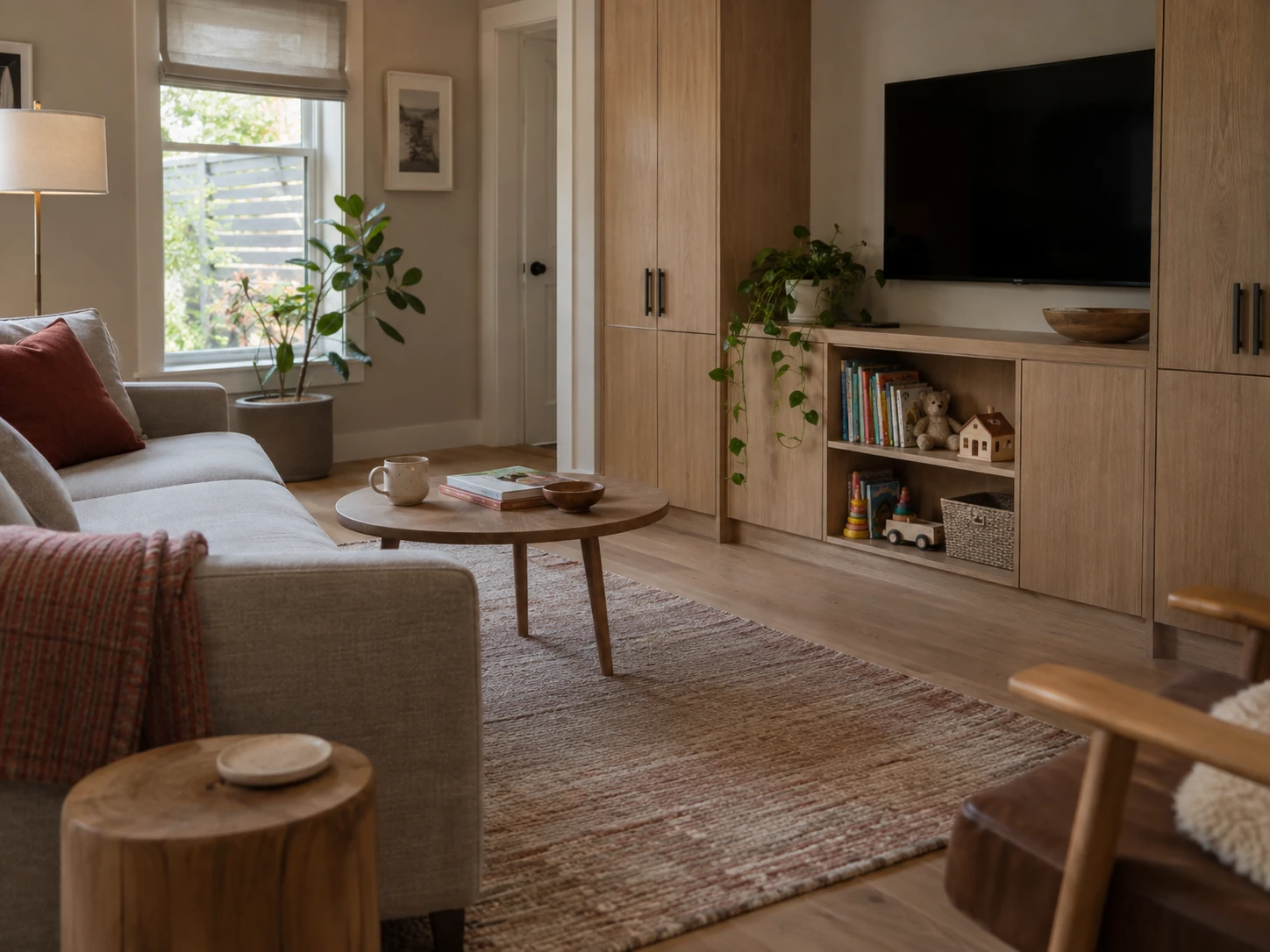
Parents in recent small-living-room discussions often describe the same tension: open storage lets a child choose toys independently, but an entire room of open shelves can feel chaotic. The answer does not have to be all open or all closed.
Keep a small active toy rotation in low, easy-to-reach open bins or shelves and move the rest behind doors or into labelled containers. Rotate categories rather than putting every toy on display at once.
Closed cabinets can handle the visually noisy majority while one reachable shelf preserves independence. Store heavier items low, and never use the top of tall furniture for toys or objects that may encourage climbing.
Avoid the deep-toy-chest problem
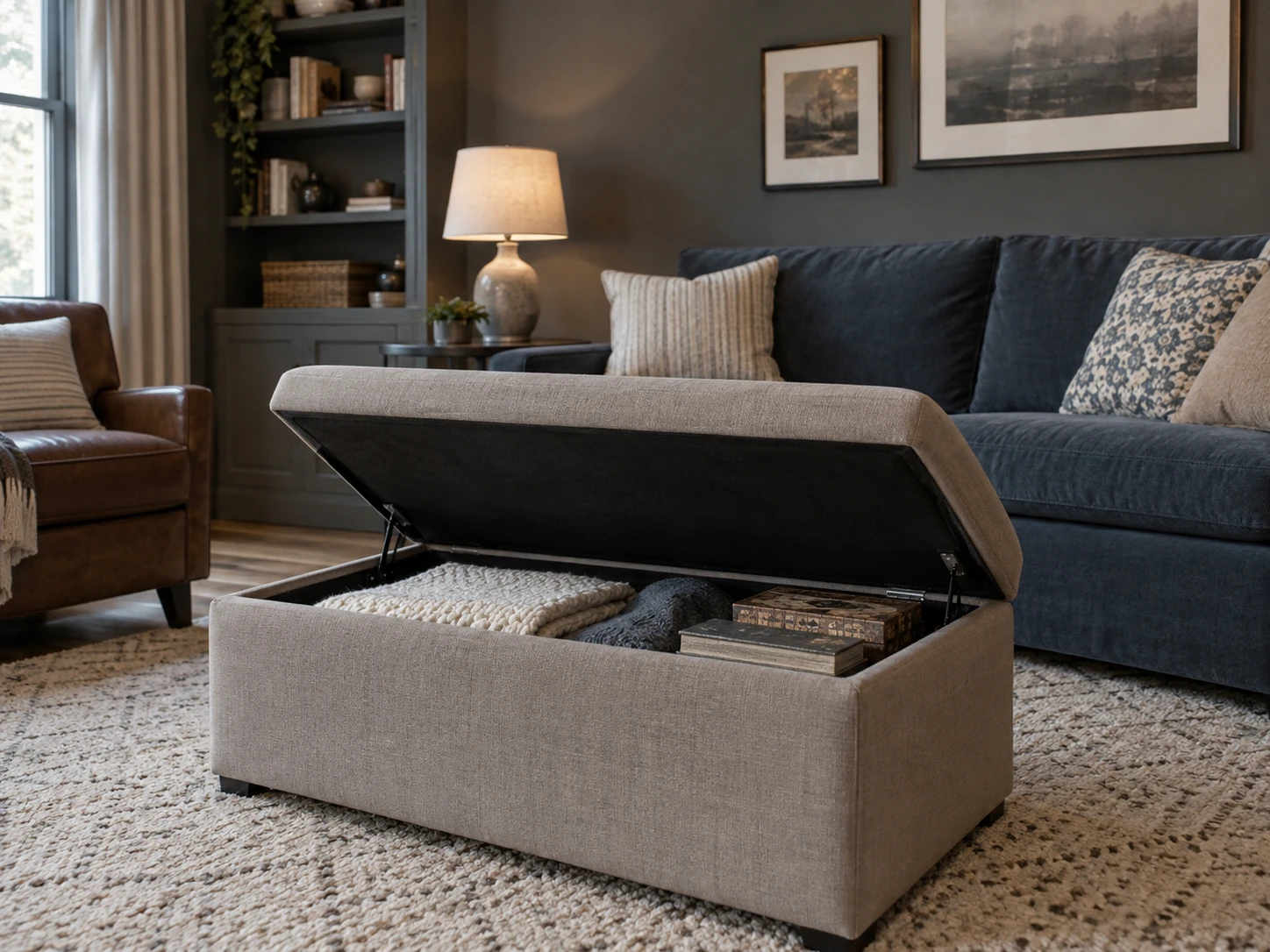
A large trunk or deep ottoman looks efficient because it holds a lot, but it can be frustrating when the wanted toy is underneath everything else. The same problem applies to blankets, games and hobby supplies.
Deep storage works best for one broad category that can be lifted out easily, such as spare blankets. For many small categories, shallow drawers, bins or shelves reduce the need to empty the entire container.
If a storage ottoman is also the coffee table, check lid access and whether opening it requires moving a tray, laptop or other objects every time.
Use the sofa footprint only when the storage is genuinely accessible
Storage sofas, lift-up chaise compartments and bins behind the sofa can be useful because the sofa already occupies a large footprint. IKEA’s current compact-living examples use both sofa-integrated storage and concealed space behind seating.
But hidden storage is only useful when the access path is realistic. If retrieving a blanket requires moving the entire sofa, that category will probably migrate elsewhere.
Use the most awkward hidden zones for occasional items, not daily controls, chargers or toys.
| Multifunctional furniture | Strongest use case | Before buying | Potential frustration |
|---|---|---|---|
| Storage ottoman | A removable place for soft items plus occasional footrest or movable seating | Check outside footprint, lid-open height and safe manufacturer load limits | A heavy lid or narrow opening makes frequent retrieval awkward |
| Lift-top coffee table | Seated laptop or meal use plus discreet storage in one footprint | Check top lift reach, clearance around sofa and what must be moved before opening | Lifting a full tabletop disturbs items and can block the walkway |
| Drawer or shelf coffee table | Frequently used remotes, magazines and games with simple access | Confirm drawer extension, leg space and cleaning reach | Visible shelves become a clutter magnet without a daily reset |
| Sofa with storage chaise | Blankets and low-frequency extras without another freestanding cabinet | Check chaise orientation, seat-lift mechanism, surrounding furniture and access | Large compartments are hard to reach if the sofa is against a wall |
Go vertical, but keep heavy and daily items lower
Tall bookcases and wall cabinets can multiply capacity without increasing floor depth. They are especially useful for books, display objects, media and archives when one wall can carry the visual weight.
CPSC’s current Anchor It guidance says to secure TVs and furniture such as bookcases and dressers and to store heavier items on lower shelves or drawers. That safety logic belongs in the storage plan, not as an afterthought.
Frequently used objects should stay within easy reach. High shelves are better for lighter, occasional categories that do not require daily climbing or stretching.
Use the space behind or beside the sofa only if the route survives
A shallow shelf or console behind a sofa can provide charging, lighting or storage when the sofa is floating away from a wall. In some compact layouts, even a narrow drawer unit behind the sofa can use an otherwise dead strip.
Measure the sofa plus the added depth as one combined footprint. If the extra surface pushes the seating zone into the main route, it is not free space.
Behind-sofa storage works best when the room already needs the sofa to float for zoning or circulation reasons.
Choose baskets because they improve access, not because they match
Baskets are useful inside open shelving because they turn many small objects into a removable category. They can also hide irregular shapes without adding a door.
The label and size matter more than visual uniformity. A basket that contains “chargers” or “small toys” is easier to maintain than a decorative basket whose contents change constantly.
Do not buy matching containers before reducing and grouping the contents. Otherwise the room gains another layer of objects without solving the underlying category problem.
Give paperwork and charging a very small home
Paper and cables are high-clutter categories because they spread quickly. They rarely need a large piece of furniture, but they need a defined one.
One shallow drawer, file box or closed cabinet section can hold active paperwork. A cable tray, drawer or charging station can contain electronics close to the outlets they use.
Do not route extension cords across the main walking path simply to make a chosen storage wall work. Power access is part of the layout decision.
For renters, prioritize modular and freestanding systems
Modular cabinets, bookcases, storage ottomans, freestanding media units and stackable bins can move to another home more easily than highly room-specific built-ins.
Wall-mounted products still need to be installed as their manufacturer requires. Rental status does not make an unsafe fastening method acceptable. If anchoring is required, discuss an approved method with the property owner.
Choose systems that can be reconfigured when the room changes function. That flexibility is often more valuable than making the storage look permanently built in.
Use this storage reset before you shop
List the categories. Decide what must remain visible. Decide what needs daily reach. Concentrate the categories into the fewest sensible zones. Measure the available depth and door or drawer opening space. Then choose the storage format.
If the room still needs several new cabinets after that exercise, review whether the living room is storing categories that could live elsewhere.
The goal is not maximum storage volume. It is enough accessible storage that the room can be reset quickly without sacrificing the space needed to sit, walk and use the room.
- Every storage category has a named home.
- Open storage is deliberately limited.
- Closed storage handles visually noisy categories.
- Daily-use items are easy to reach.
- Heavy items stay lower where practical.
- Media furniture suits the TV and equipment it supports.
- Tall furniture and TVs can be secured as required.
- Doors and drawers open without blocking the route.
- Multifunctional storage is accessible without moving other furniture.
- The room can be reset in a few minutes.
Keep the visual summary.
This is the condensed version of the guide, useful when you are planning, comparing options or returning to the key decisions later.
Where the measurable guidance comes from
By Sady's styling advice is editorial. Where this guide uses measurements or specific planning guidance, these are the references used. Always measure your own room and follow local electrical and building requirements.
- IKEA U.S.: Work, play, repeat — a little living room with endless possibilities
Current reference for combining open, closed and hidden storage in a compact living-work room.
- IKEA U.S.: How to furnish your living room with open and closed storage
Current reference for assigning different living-room categories to open and closed storage.
- IKEA U.S.: Shared spaces and smart storage places
Current reference for sofa-based storage and organizing shared living-room categories.
- U.S. CPSC: Anchor It!
Primary safety guidance for securing TVs and furniture and storing heavier items lower.
- Reddit r/interiordecorating: living room toy-storage discussion
Community evidence of the open-versus-closed toy-storage trade-off in a shared living room; used to identify a real-world problem, not as authoritative safety guidance.
More from Living Rooms.
Coffee Table Styling Ideas: A Practical Formula That Still Leaves Room to Live
A practical coffee-table styling guide built around table shape, daily use, object scale, trays, books, organic elements and leaving enough empty surface for real life.
Neutral Living Room Ideas: How to Make a Calm Room Feel Warm, Layered and Intentional
A practical guide to neutral living rooms that feel warm rather than flat, using undertones, value contrast, texture, wood, lighting, rugs, art and a small controlled palette.
Small Living Room Ideas: A Practical Guide to Layout, Seating, Storage and Flow
A measurement-first guide to small living rooms, covering sofa size, walking routes, coffee tables, rugs, TV placement, storage and rooms that also need dining or work space.