
Small Bedroom Lighting Ideas: Layered Light Without Losing Surface Space
A practical lighting plan for compact bedrooms, from wall-mounted reading lights and wardrobe lighting to color temperature, controls and evening ambience.
Small bedrooms expose bad lighting quickly: one ceiling fixture leaves the bed, wardrobe and evening routine asking the same light to do four different jobs.
Part of the By Sady guide Small Bedroom Ideas: Complete Guide →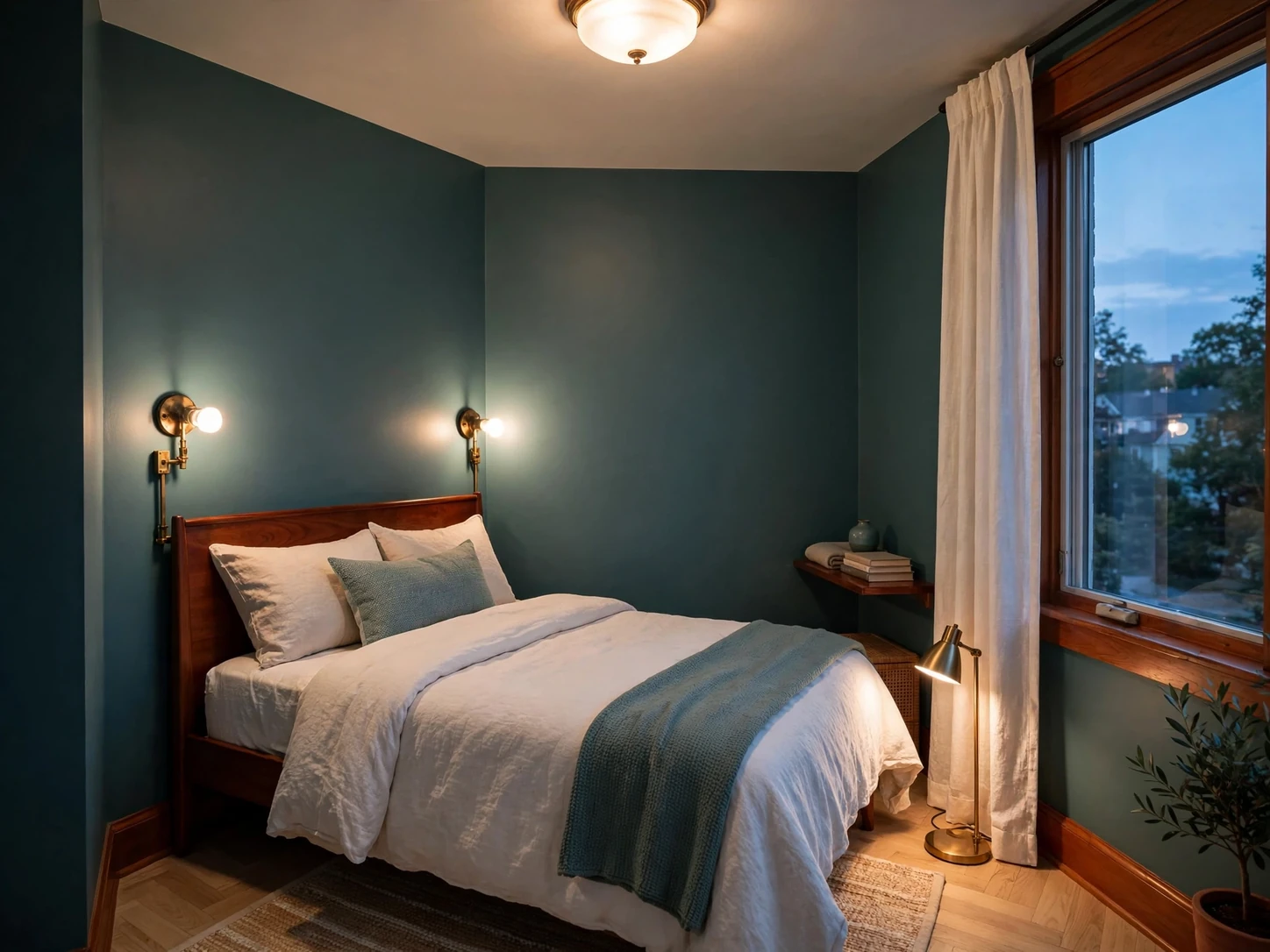
What matters most
- 01
Use several modest light sources for different tasks instead of asking one ceiling fixture to do everything.
- 02
Wall-mounted bedside lighting can free valuable nightstand surface in a compact room.
- 03
Keep visible bulb color appearance consistent; 2700–3000 K is a common warm residential range.
- 04
Light the wardrobe or dressing zone according to the task, not only the center of the room.
- 05
Plan controls as carefully as fixtures so useful lights are easy to switch from where you actually use them.
Start with tasks, not fixtures
Before choosing a lamp, list what the room needs light for: entering safely, reading in bed, getting dressed, using a desk or vanity, finding clothing, cleaning and winding down at night. Those tasks happen in different places, so a single central fixture is rarely the most useful answer.
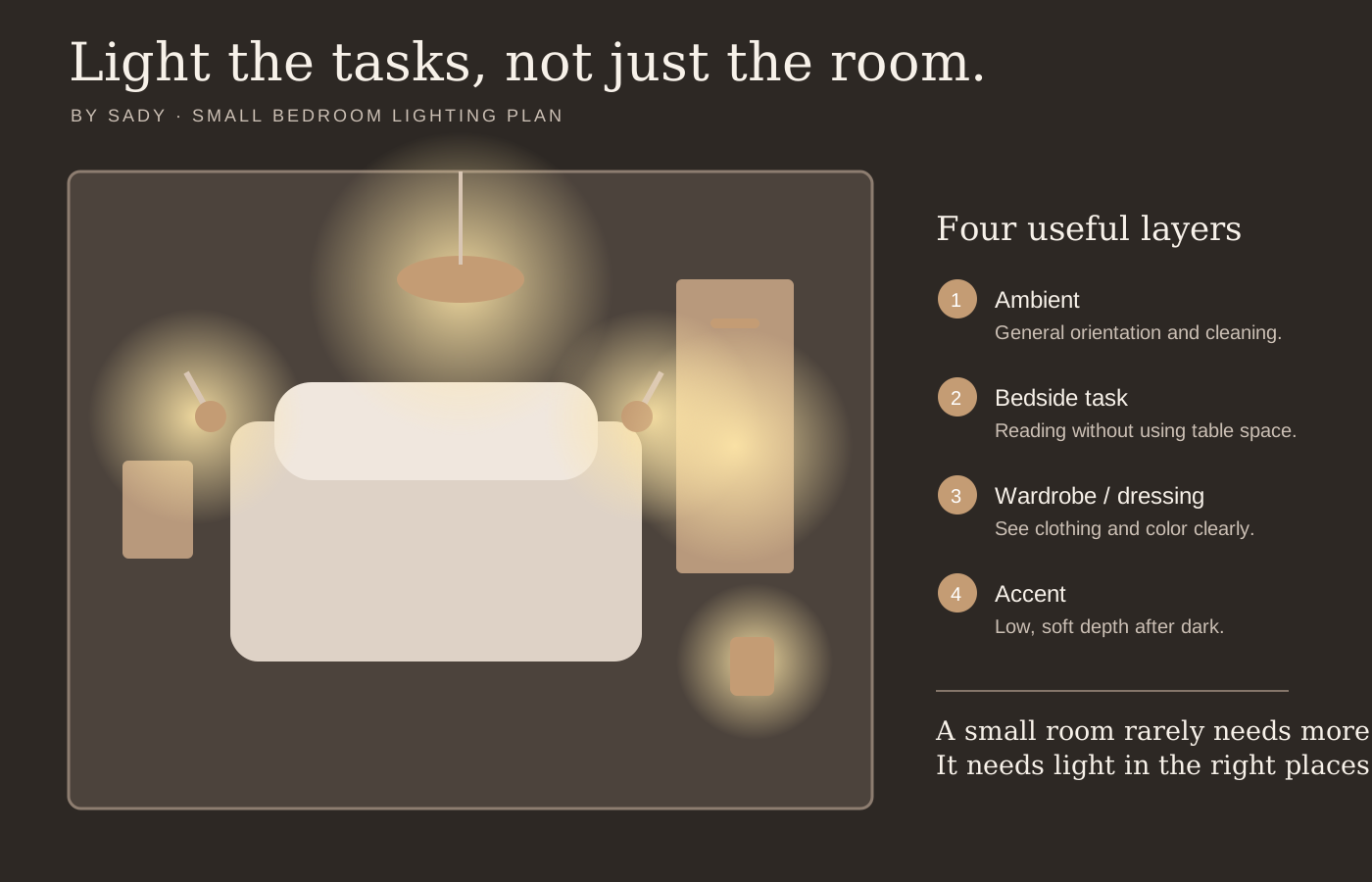
Think in layers. Ambient light helps you see the room as a whole. Task light gives focused illumination for reading, dressing or working. Accent light adds a lower pool of light that makes the room feel less flat after dark.
The goal in a small bedroom is not maximum brightness. It is putting enough light close to each job so you do not need to over-light the entire room.
Match each lighting job to the smallest fixture that solves it
Compact bedrooms benefit from restraint because every lamp also occupies visual or physical space. Instead of collecting fixtures, assign one lighting job to each source and combine jobs only when the fixture can do both well.
This keeps the room easier to control. A ceiling light can handle cleaning and general orientation. A directional wall light can handle reading. Integrated wardrobe light can solve dressing visibility without brightening the whole room. A low lamp or dimmed source can take over in the hour before sleep.
The matrix below is a useful starting point when you are deciding what the room actually needs.
| Bedroom task | Best starting layer | Small-room advantage | Watch for |
|---|---|---|---|
| Entering, cleaning, finding dropped items | General ceiling or broad ambient light | One source gives quick whole-room visibility | A bright central fixture alone can feel harsh at night |
| Reading in bed | Directional bedside wall, clamp or compact task light | Puts light close to the page without occupying much surface | Glare in the eyes or a fixed beam that misses the reading position |
| Getting dressed | Wardrobe or dressing-zone light | Illuminates clothing where color and detail matter | Lighting only the ceiling while the wardrobe interior stays dark |
| Desk or vanity work | Focused task light plus some ambient light | Lets the work surface be bright without over-lighting the bed | Reflections in screens or mirrors and shadows across the task |
| Winding down | Low dimmable lamp or indirect accent light | Creates a calmer evening layer without adding furniture if wall-mounted | Mixing very different visible bulb colors in the same view |
Free the nightstand with wall-mounted bedside light
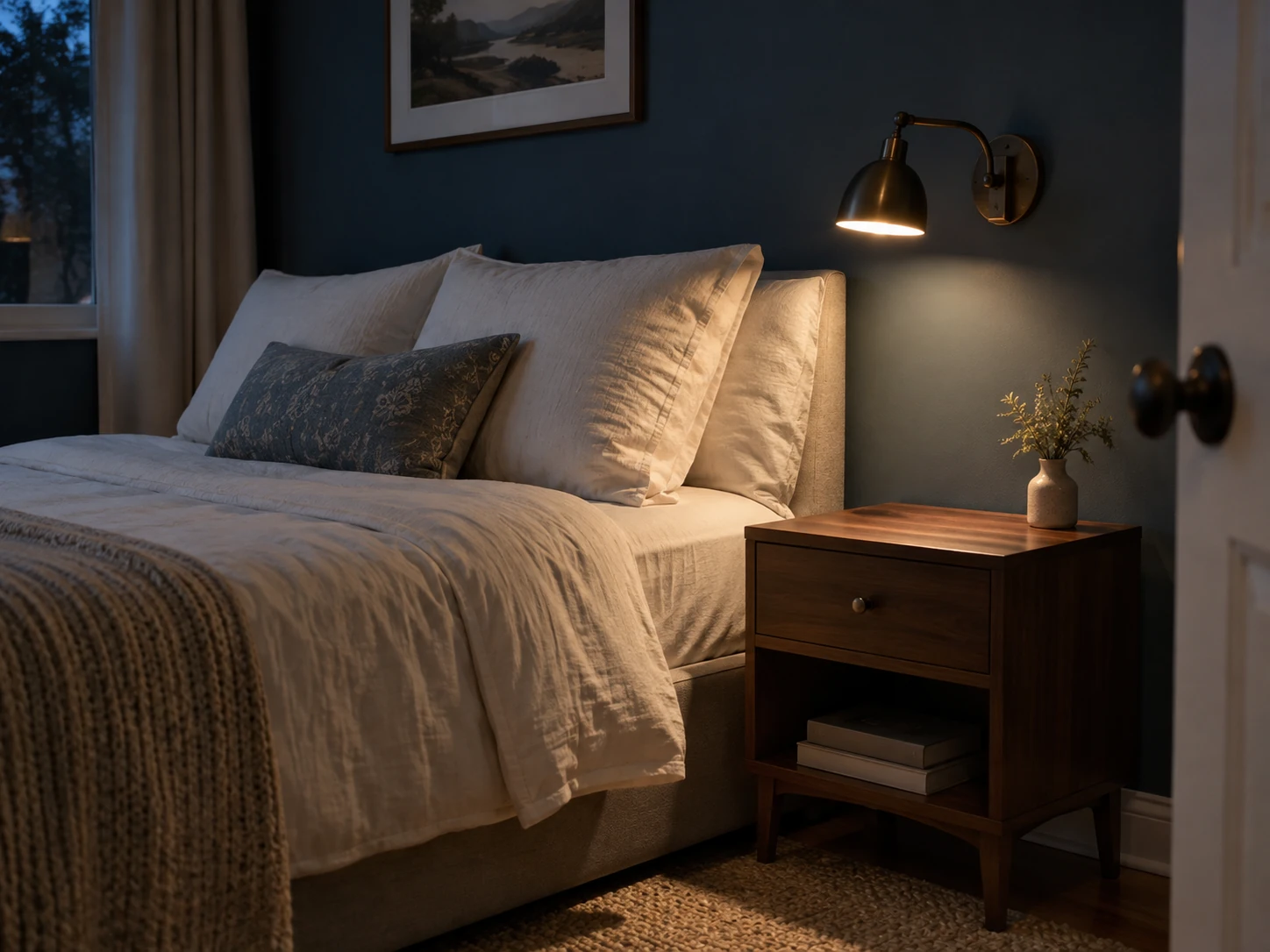
A table lamp can consume most of a narrow bedside surface. Wall sconces, plug-in swing-arm lights and compact wall lamps move the light source away from the table and leave room for a glass, phone, book or medication.
Architectural Digest designers specifically recommend wall-mounted sconces in tight bedrooms because they preserve bedside surface area while still providing focused reading light.
Position a reading light according to the person using the bed rather than centering it decoratively on the nightstand. Adjustable arms or heads are useful because they let the beam move toward a book and away again when not needed.
Use the ceiling fixture for orientation, not every activity
A ceiling light is useful for entering, cleaning and general visibility. It does not need to be bright enough to replace every other source in the room.
If ceiling height is limited, a flush or semi-flush fixture can preserve headroom. If the ceiling is taller, a pendant can become a visual anchor, but check that its drop does not interfere with walking routes, wardrobe doors or the view across the room.
Put the central fixture on a dimmer when the fixture and bulbs support it. That gives the same source more range without requiring a second ceiling installation.
Light the wardrobe where you actually need to see color
Wardrobe lighting is easy to ignore until dark clothing disappears into a dark cabinet. A nearby directional ceiling light, wall light or integrated wardrobe light can be more useful than simply increasing the brightness in the middle of the bedroom.
Keep the light in front of you rather than directly behind you when dressing at a mirror. Backlighting your body can create shadow where you are trying to see details.
For integrated cabinet lighting, use products intended for that application and follow installation instructions carefully. If wiring changes are required, use an appropriately qualified professional and follow local electrical requirements.
Choose color appearance deliberately
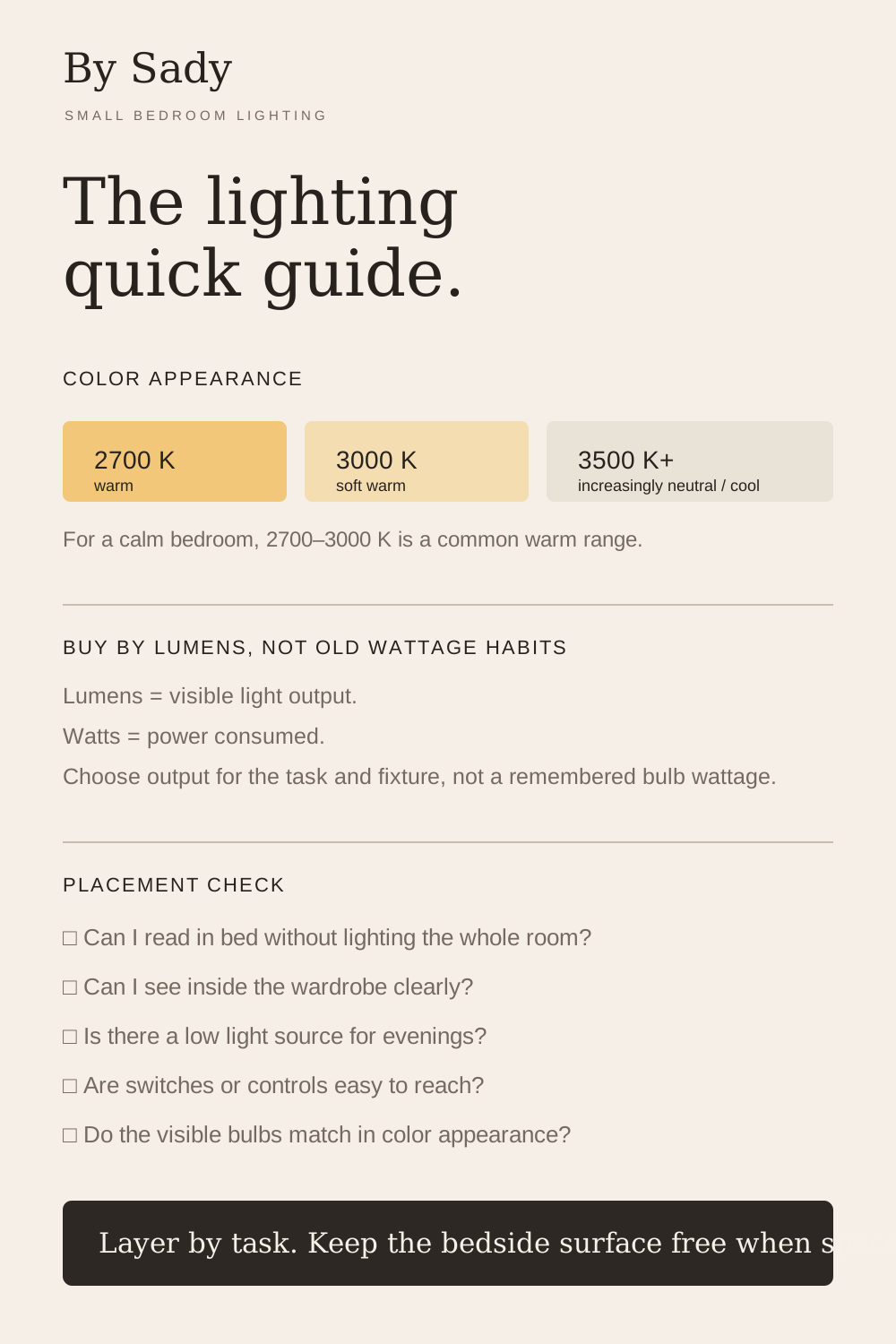
Light color is commonly described by correlated color temperature, measured in kelvin. The U.S. Department of Energy describes 2700 K as warm and 3000 K as a soft warm light commonly used in homes, while higher values appear progressively more neutral or cool.
For a bedroom that should feel calm and comfortable, keeping most visible light sources in a similar warm range helps the room feel coherent. Mixing a very warm bedside lamp with a noticeably cool ceiling bulb can make the palette feel disjointed even when the fixtures themselves look good.
You do not need to obsess over an exact number for every product, but check the CCT on the packaging or specifications before buying replacement bulbs.
Buy light output in lumens, not by old wattage habits
With modern LED lighting, wattage tells you how much power a lamp uses rather than how much visible light it produces. The Department of Energy advises looking at lumens when comparing light output.
This matters in a small bedroom because a compact fixture can still be very bright. Choose output according to the task, the shade or diffuser and the distance from the surface you are lighting.
Reading lights usually benefit from direction and control more than sheer room-wide brightness. A focused source close to the book can be useful without turning the whole bedroom into a brightly lit workspace.
Add one low evening light
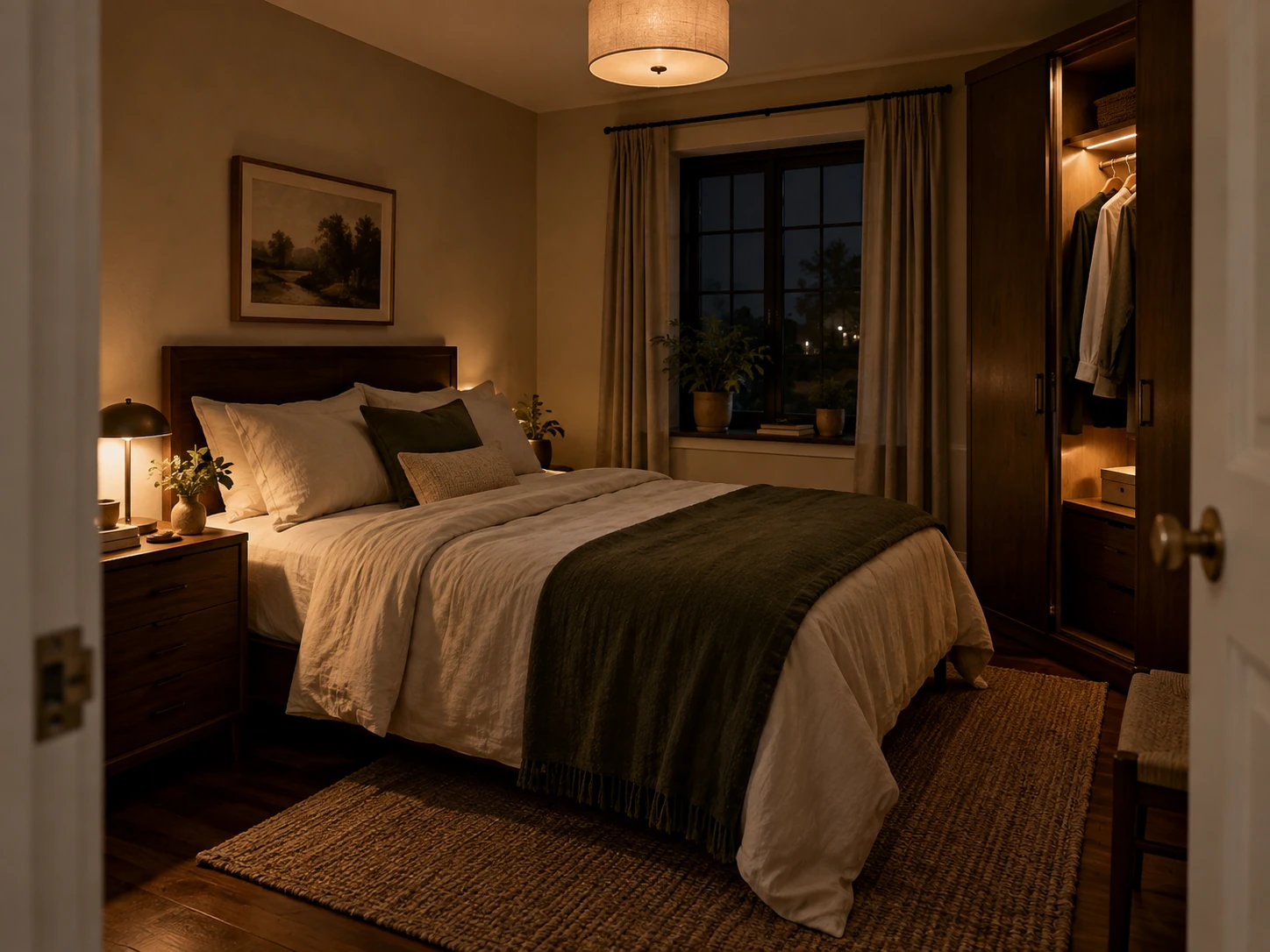
A small lamp on a dresser, a low wall light or a dimmable source creates a useful evening layer below eye level. It gives the room depth and lets you move around without relying on the brightest overhead source.
This light does not need to be decorative clutter. One compact source in the right location can change the feel of the entire room after dark.
If a dresser is already crowded, place the accent source on a wall shelf, use a small plug-in sconce or choose a fixture that is integrated with another function.
Use lighting to reduce furniture, not add more
Small bedrooms become crowded when every function demands another object. A wall light can remove the need for a large nightstand lamp. A mirror with integrated lighting can eliminate a separate vanity lamp. A desk lamp that rotates toward the wardrobe can occasionally serve two nearby tasks.
Do not force one fixture to serve conflicting jobs if the result is poor light in both places. The point is thoughtful overlap, not maximum multifunctionality.
The strongest small-room lighting plans often use fewer fixtures than expected, but each fixture has a clear role.
Plan the controls from the bed and the doorway
A well-placed light is frustrating if the switch is inconvenient. Ideally, the room should have an easy way to turn on a useful light when entering and another way to control bedside light from bed.
Plug-in sconces with inline or fixture-mounted switches can be practical for renters. Smart bulbs or smart plugs can add control without rewiring, provided the products are compatible with the fixture and used as intended.
Keep the routine simple. If controlling the evening lighting requires opening several apps or reaching behind furniture, the system will not feel luxurious for long.
Use mirrors and light together
A mirror can help redistribute available light, but its placement matters. A mirror near or across from a window can reflect daylight deeper into the room, while a mirror positioned near a lamp can multiply glare if the bulb is directly visible.
Stand in the normal viewing position and check what the mirror reflects both during the day and at night. The reflected view should be useful or calm, not a bright exposed bulb.
For dressing, prioritize even illumination on the face and clothing over a dramatic backlit effect that may look good but makes details harder to see.
Avoid common small-bedroom lighting mistakes
The most common problem is relying on one bright central source. The next is using several lights that all operate at the same height and color but still fail to illuminate the actual tasks.
Another mistake is choosing a large decorative lamp before checking the surface it will occupy. A beautiful lamp that leaves no room for a glass or book is not a good small-bedroom solution.
Finally, do not ignore cords. Plan where plugs are, how cords will reach them and whether the route creates a trip or visual-clutter problem. Cord management is part of the lighting plan.
- One harsh ceiling light and no task lighting.
- Oversized table lamps on narrow nightstands.
- Visible bulbs with noticeably different color appearance.
- Reading lights positioned for symmetry instead of the reader.
- Desk or vanity light placed behind the user.
- Cords stretched across circulation routes.
Choose the fixture after the location is solved
Once you know where the light must be and what it must do, the shopping criteria become much clearer. For a bedside source, compare reach, adjustability, mounting method, switch position and shade direction. For a ceiling fixture, compare drop, diffusion and dimming compatibility. For a dresser lamp, compare footprint as carefully as style.
This keeps the shopping process attached to the room plan. You are not buying “a beautiful lamp”; you are buying a light that solves a measured task in a specific location.
That is the By Sady rule for small spaces: every object should earn the space it occupies.
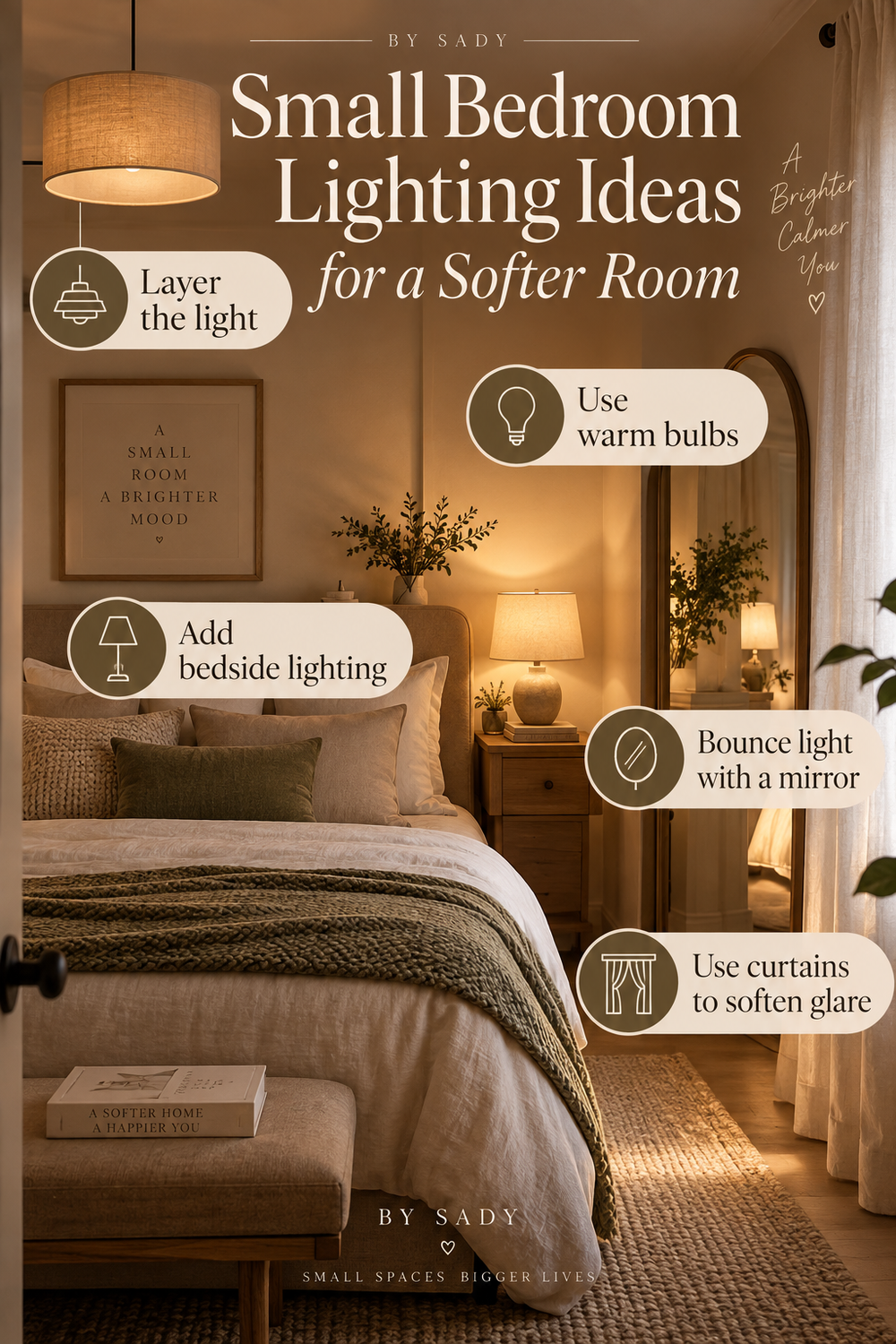
Keep the visual summary.
This is the condensed version of the guide, useful when you are planning, comparing options or returning to the key decisions later.
Where the measurable guidance comes from
By Sady's styling advice is editorial. Where this guide uses measurements or specific planning guidance, these are the references used. Always measure your own room and follow local electrical and building requirements.
- IKEA U.S.: The art of bedroom lighting
Current reference for planning separate bedroom lighting zones including wall-mounted, wardrobe and movable sources.
- U.S. Department of Energy: Purchasing Energy-Efficient Light Bulbs
Reference for correlated color temperature and common warm residential CCT descriptions.
- U.S. Department of Energy: Consumer Guide to Energy-Efficient Lighting
Reference for comparing modern light output in lumens and understanding color temperature.
- Architectural Digest: The best lighting for small spaces, according to designers
Reference for space-saving adjustable wall-mounted bedside lighting.
- Architectural Digest: Bedroom lighting ideas
Reference for using lighting at multiple heights to create depth and comfort.
- Architectural Digest: Small-bedroom ideas
Current small-bedroom design examples including wall sconces and vertical solutions.
More from Small Bedrooms.
Small Bedroom Ideas: A Complete Guide to Layout, Storage, Lighting & Style
A practical small-bedroom design guide built around floor planning, circulation, storage, lighting and the details that make a compact room feel calm instead of crowded.
Small Bedroom Storage Ideas: A Practical System for Finding More Space
A storage-first guide for small bedrooms, with a simple system for deciding what belongs under the bed, beside it, on the walls, inside the wardrobe and out of sight.
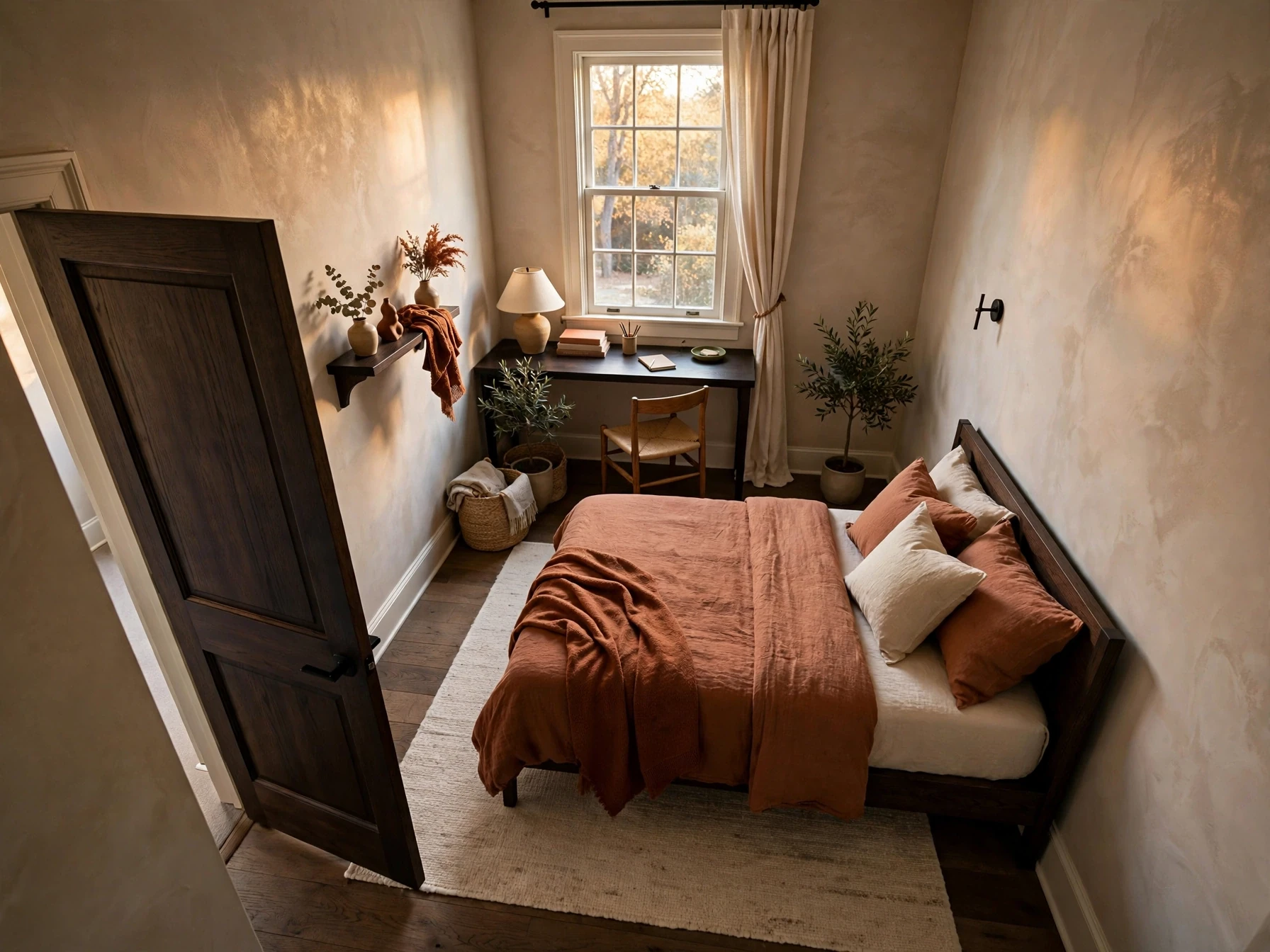
Small Bedroom Layout Ideas: How to Plan the Bed, Storage and a Desk
A practical floor-planning guide for small bedrooms, including queen-bed layouts, narrow rooms, one-sided access, wardrobe clearance and bedroom-office combinations.